Complete Guide for Spot Trading
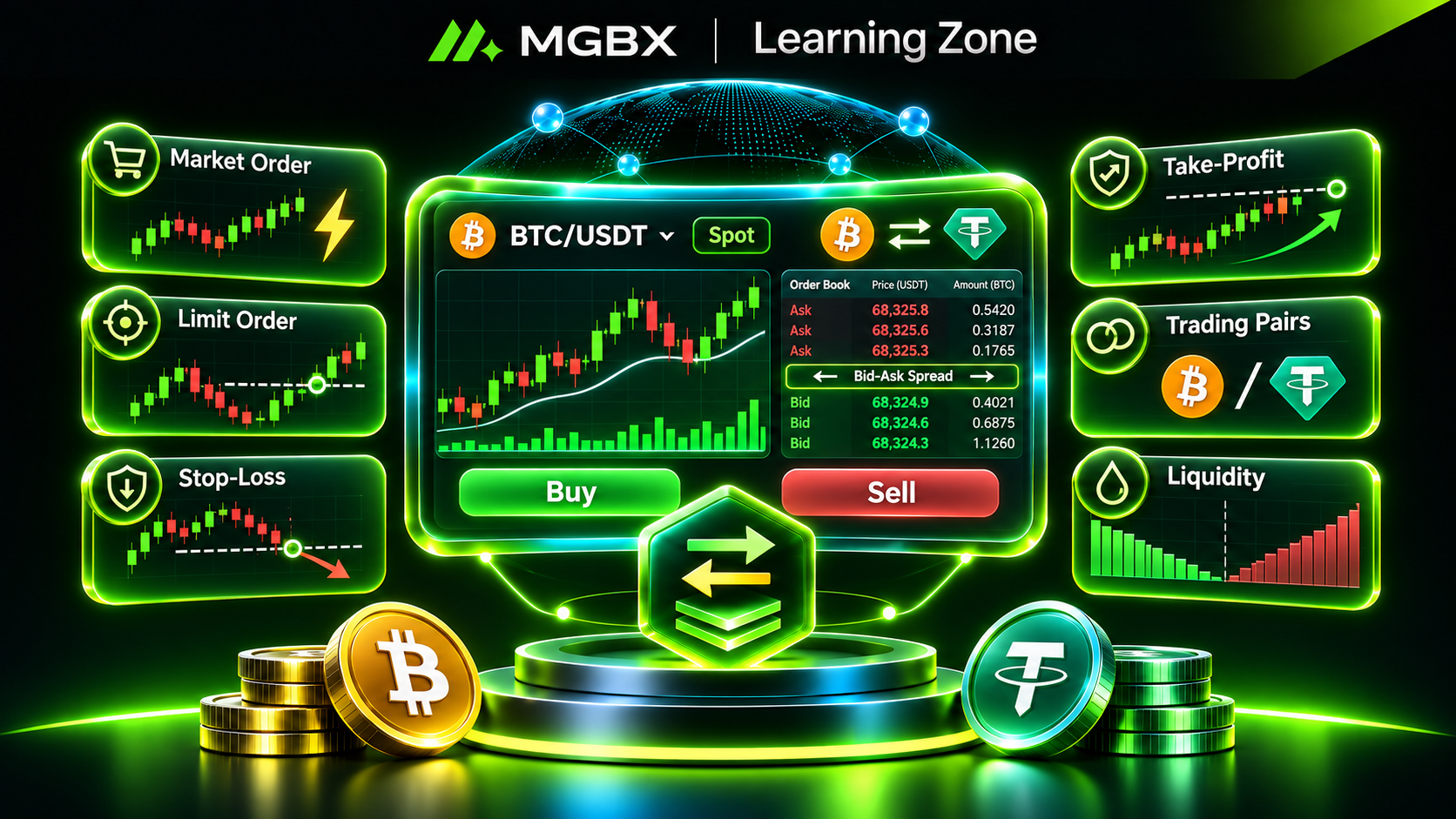
Spot trading is one of the most fundamental ways to trade crypto assets. The basic idea is simple: traders buy or sell digital assets directly and receive the corresponding assets once an order is filled. What matters most is understanding how prices are formed, how orders are matched, and when different order types are used. This guide covers the fundamentals of spot trading, including order books, market orders, limit orders, stop-loss orders, and take-profit orders, to help beginners build a practical trading framework.
What Is Spot Trading?
Spot trading refers to the direct exchange of one asset for another under current market conditions.
For example, in the BTC/USDT trading pair, a trader uses USDT to buy BTC. Once the order is filled, the USDT balance decreases while the BTC balance increases. If the trader later sells BTC, it can be exchanged back into USDT.
This differs significantly from futures trading. Standard spot trading involves buying and selling the underlying asset directly and does not rely on margin to maintain a leveraged position. As a result, it does not involve the same liquidation mechanism found in leveraged futures contracts.
However, this does not mean spot trading is risk-free. If the market price of an asset falls, the value of the holdings can also decline substantially.
For beginners, the priority should be understanding the relationship between trading pairs, order types, execution prices, and liquidity before moving on to more complex strategies.
How Is a Spot Trade Executed?
Users wishing to do spot trading on MGBX may refer to How to Conduct Spot Trading on MGBX.
Most centralized crypto exchanges process spot trades through an order book and a matching engine.
The order book records buy and sell orders that are waiting to be filled. The highest available buy price is known as the best bid, while the lowest available sell price is the best ask. The difference between the two is called the bid-ask spread.
When buy and sell orders meet compatible price conditions, the matching engine executes the trade according to the platform's rules. Common matching principles include price priority and time priority, although the exact process may vary by exchange.
Liquidity is another important factor. When a trading pair has many orders distributed across nearby price levels, orders are generally more likely to be filled close to the expected price. In a thin order book, however, a larger order may need to match across several price levels, which can noticeably affect the average execution price.
For this reason, the “last price” shown on the screen does not mean every order can be fully executed at that exact price.
How Do You Choose Between Market, Limit, Stop-Loss, and Take-Profit Orders?
The two most common basic order types in spot trading are market orders and limit orders.
A market order prioritizes execution speed. Once submitted, it matches against the best available prices in the order book. This usually allows the trade to be completed quickly. However, if the market is moving rapidly, the order is large, or liquidity is limited, the average execution price may differ from the price shown when the order was placed. This difference is commonly known as slippage.
A limit order gives traders more control over price. A trader can set the highest price they are willing to pay when buying or the lowest price they are willing to accept when selling. This helps define the acceptable execution price, but it does not guarantee that the order will be filled.
Stop-loss and take-profit orders are designed to help plan exits in advance. Traders set predefined trigger conditions, and once the market reaches the specified level, the system submits an order based on the selected settings.
No single order type is suitable for every market condition. Market orders prioritize execution, limit orders prioritize price control, while stop-loss and take-profit orders help traders plan exit conditions in advance.
What Should Beginners Pay Attention to in Spot Trading?
When trading spot markets, beginners should keep the following points in mind.
Understand the difference between owning an asset and making a profitable investment. Buying an asset does not reduce the risk of its market price falling.
Pay attention to liquidity. In lower-volume markets, even a relatively small market order may experience noticeable slippage.
Define risk limits in advance. Consider how much capital to allocate, how much price volatility you can tolerate, when to stop adding to a position, and under what conditions to exit. These rules are often more useful for building a repeatable trading process than simply trying to find the perfect entry price.
FAQ
Is spot trading suitable for beginners?
Spot trading has a relatively straightforward structure and does not involve the margin and liquidation mechanics commonly associated with leveraged futures. However, crypto prices can still fluctuate significantly.Can I hold assets purchased through spot trading long term?
Standard spot holdings generally do not have an expiration date. Whether to continue holding depends on your own strategy, the risks of the asset, and market conditions.Are spot orders always filled immediately?
No. Market orders are generally more likely to execute quickly, while limit orders may remain open, be partially filled, or not be filled at all.
Mastering the basics is the first step. Follow MGBX Academy to access more cryptocurrency educational resources and market opportunities.
The process for trading on MGBX:
Register a trading account and complete the necessary identity verification;
Deposit funds and select a trade type;
On the cryptocurrency trading page, enter the amount or quantity of the cryptocurrency you wish to purchase;
Confirm the order to complete the trade, and check that your assets have increased accordingly.
Further Readings:
What Is Spot Trading? The Simplest Way to Buy Crypto
How Spot Trading Works: A Detailed Guide
Complete Guide to Market Orders: Speed, Benefits, and Risks
Complete Guide to Limit Orders: Trading With Greater Price Control
Stop-Loss and Take-Profit Orders: Essential Tools for Risk Management