Leveraged Trading Explained: Amplifying Both Returns and Risk
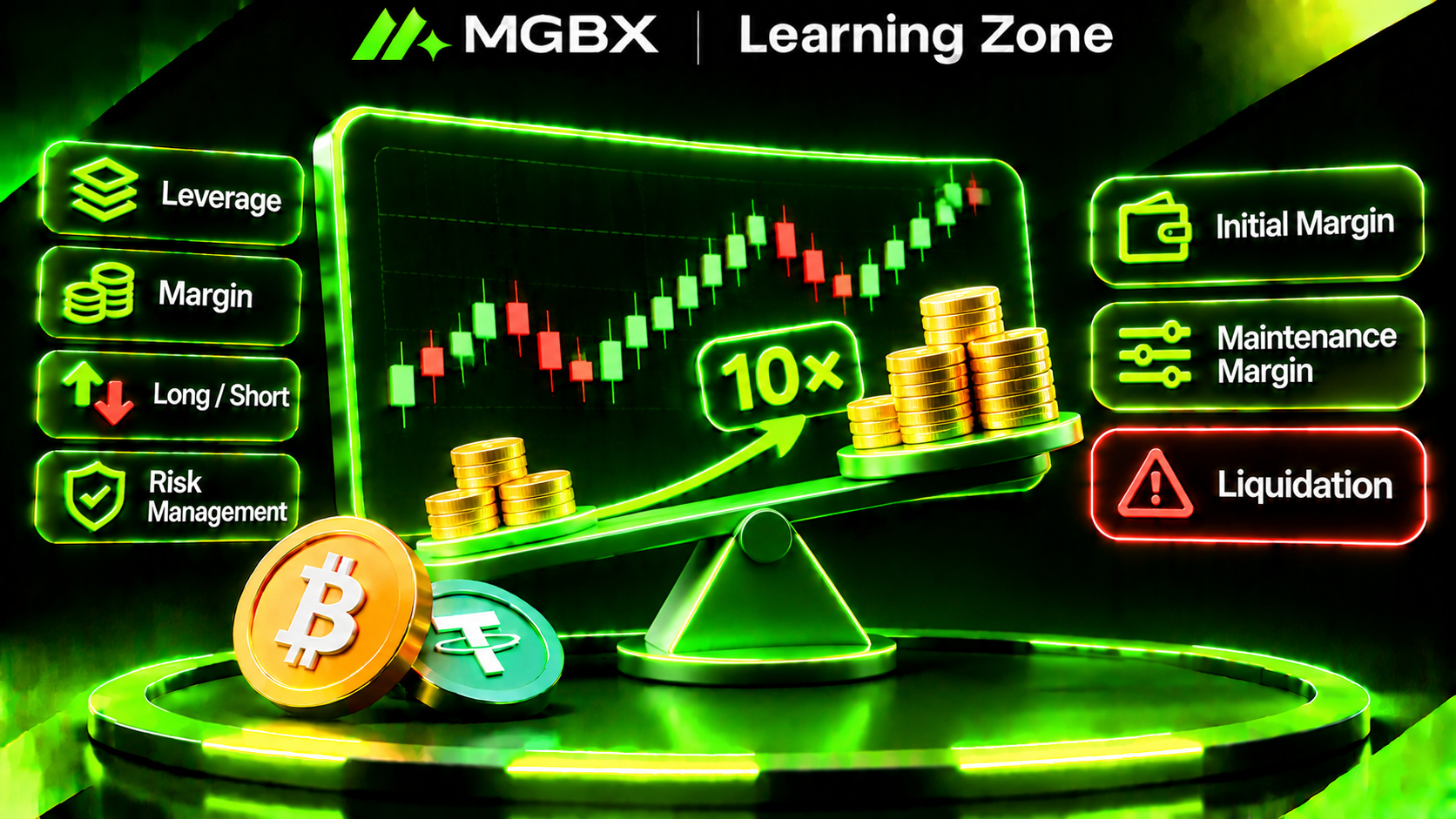
Leveraged trading allows traders to use margin to open positions with a larger notional value than the capital committed. Higher leverage can improve capital efficiency, but it also makes changes in market prices have a greater impact on margin. Understanding initial margin, maintenance margin, notional position value, and liquidation is therefore more important than simply choosing a higher leverage ratio and forms a key part of futures risk management.
What Is Leveraged Trading?
The core purpose of leveraged trading is not to automatically multiply returns. Instead, it allows traders to use a certain amount of margin to control a position with a larger notional value.
It is also important to distinguish between different forms of leverage. In spot margin trading, leverage may involve borrowing assets. In derivatives such as perpetual futures, leverage mainly reflects the relationship between margin and the notional value of a position. It should not simply be understood as the trader directly borrowing several times their capital from the platform.
For example, under simplified conditions, using 1,000 USDT in margin with 10x leverage to open a fully utilized position would correspond to a notional value of approximately 10,000 USDT. If the underlying asset moves by 1%, the position value would change by around 100 USDT. Relative to the 1,000 USDT margin, that represents roughly a 10% change.
Actual profit and loss, however, can also be affected by trading fees, funding payments, execution price, and margin rules. Therefore, “a 1% price increase means a guaranteed 10% account gain” should not be treated as a fixed formula.
Margin System: Initial Margin vs Maintenance Margin
The margin system is the foundation of leveraged trading. Two of its most important concepts are initial margin and maintenance margin.
Initial margin is the amount of margin required to open a position. Under simplified conditions, it can be understood as “notional position value ÷ leverage.” For example, a 10,000 USDT position using 10x leverage would require approximately 1,000 USDT in initial margin.
Maintenance margin is one of the minimum requirements that must be met for a position to remain open. If the market moves against the position and the available margin is no longer sufficient to meet maintenance margin and related risk requirements, the position may enter the liquidation process.
This is also why liquidation generally occurs before the initial margin mathematically falls to zero. Maintenance margin, trading fees, risk limits, mark price, and other factors can all affect the actual liquidation price.
Under MGBX’s current futures rules, the mark price is an important reference for determining liquidation. Traders should therefore monitor the real-time liquidation price displayed on the trading page instead of relying only on simplified estimates such as “100 ÷ leverage.”
The Relationship Between Leverage and Risks
The higher the leverage ratio, the less initial margin is generally required to open the same-sized position. However, the position’s exposure relative to the committed margin also becomes greater.
This means that what traders really need to manage is not the leverage number alone, but the notional value of the position.
For example, two traders may both use 20x leverage, but one may open a position worth only a small portion of their total account balance, while the other may commit almost all available margin. Their actual account-level risk can therefore be very different.
When selecting leverage, a more disciplined approach is to first determine the maximum loss you are prepared to tolerate, then calculate position size and margin requirements based on stop-loss distance and market volatility. This is generally more effective than choosing the highest possible leverage first and considering risk afterward.
For a broader framework on futures risk, read Complete Guide to Futures Trading: From Beginner Basics to Risk Management.
FAQ
Does 10x leverage mean a 1% price increase results in a 10% profit?
Under certain simplified conditions, fully utilizing 10x leverage may result in a margin-level PnL change close to that proportion. However, actual results depend on position size, trading fees, funding payments, and other factors.Does lower leverage guarantee that a position will not be liquidated?
No. Lower leverage generally provides more room for adverse price movements, but liquidation can still occur if the market continues moving against the position.Does adding more margin always make a position safer?
Additional margin may increase the position’s ability to withstand price fluctuations, but it cannot eliminate risks caused by incorrect market direction, price gaps, or continued losses.Why is the actual liquidation price different from a simple leverage formula?
Because liquidation calculations also involve maintenance margin, trading fees, risk limits, mark price, and the platform’s specific risk parameters.
Mastering the basics is the first step. Follow MGBX Academy to access more cryptocurrency educational resources and market opportunities.
The process for trading on MGBX:
Register a trading account and complete the necessary identity verification;
Deposit funds and select a trade type;
On the cryptocurrency trading page, enter the amount or quantity of the cryptocurrency you wish to purchase;
Confirm the order to complete the trade, and check that your assets have increased accordingly.
Further Readings:
Complete Guide to Futures Trading: From Beginner Basics to Risk Management
What Is Futures Trading: Perpetual Futures vs Delivery Futures
What Is a Funding Rate? How Perpetual Futures Stay Anchored to Spot Prices