Bitcoin Ecosystem: Lightning Network, Ordinals, and BRC-20 Explained
This guide provides a comprehensive overview of the Bitcoin ecosystem, including the Lightning Network, Ordinals, and BRC-20, and explains how BTC is evolving from a store of value into a broader digital asset ecosystem.
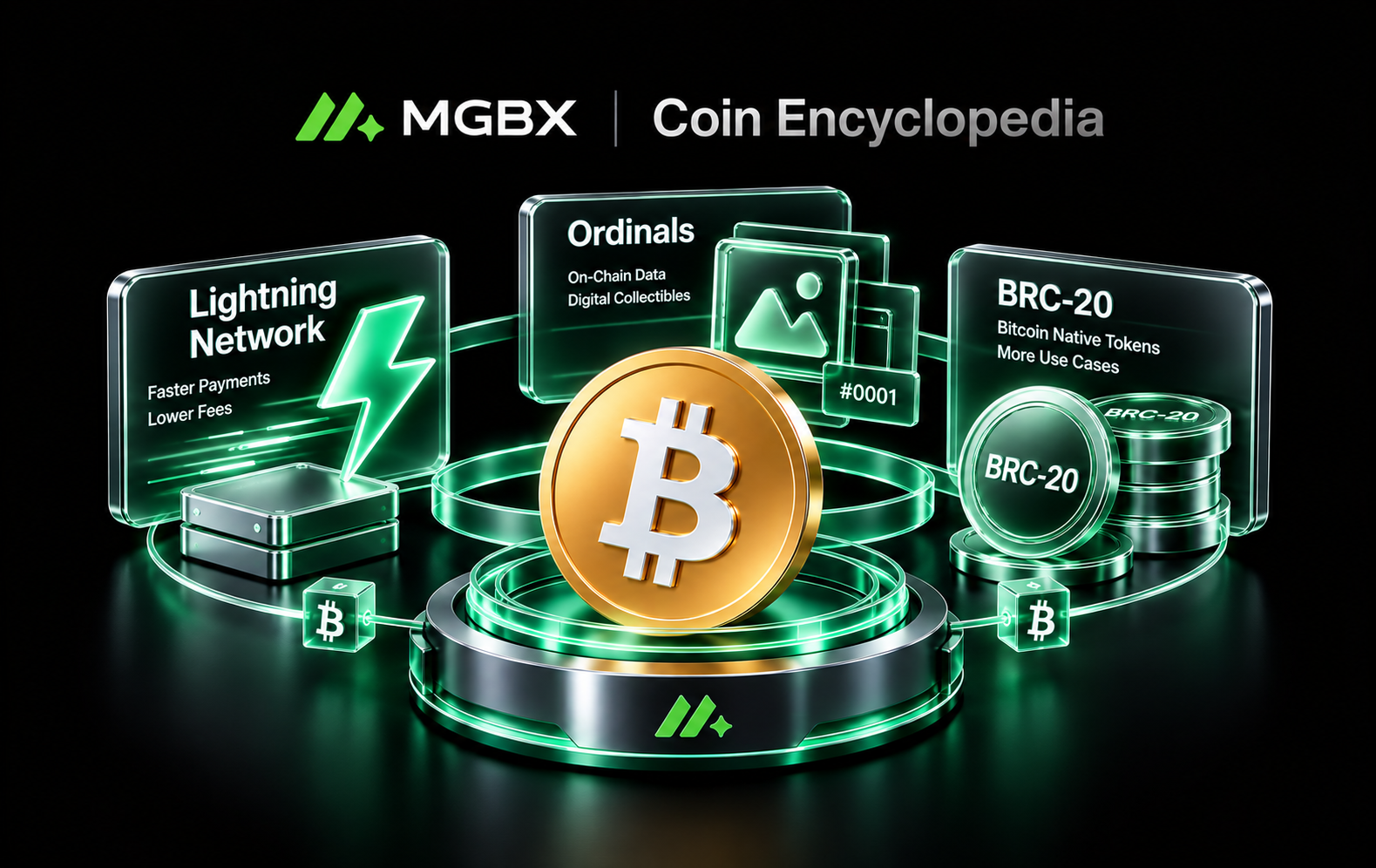
The Bitcoin ecosystem continues to expand, and BTC is no longer used only as a store of value or for peer-to-peer payments. As new technologies emerge, the Bitcoin network has developed additional use cases, including the Lightning Network for faster transactions, the Ordinals protocol for inscribing data on-chain, and the BRC-20 token standard built around Ordinals. These technologies aim to expand Bitcoin’s utility while preserving its focus on security and decentralization.
This article explains the core components of the Bitcoin ecosystem and how the Lightning Network, Ordinals, and BRC-20 are contributing to its development.
What Is the Bitcoin Ecosystem?
The Bitcoin ecosystem refers to the collection of technologies, protocols, applications, and communities built around the Bitcoin blockchain.
Bitcoin was originally designed as a decentralized digital currency for peer-to-peer value transfers without relying on third-party institutions. Because the Bitcoin network prioritizes security and decentralization, the base layer has limitations in transaction throughput and scalability. As blockchain technology has evolved, developers have explored ways to improve transaction efficiency and expand Bitcoin use cases without changing its core characteristics.
Today, the Bitcoin ecosystem includes the Bitcoin base layer, Layer 2 scaling solutions, on-chain data protocols, and asset issuance mechanisms. The Lightning Network mainly focuses on improving transaction speed and reducing certain payment costs. Ordinals enables users to record additional types of data on Bitcoin, while BRC-20 explores token-related use cases within the Bitcoin ecosystem.
These innovations do not replace Bitcoin’s role as a store-of-value asset. Instead, they introduce additional use cases built on top of the BTC network.
Lightning Network: A Layer 2 Solution for Faster Bitcoin Transactions
The Lightning Network is a Layer 2 scaling solution built on top of the Bitcoin main chain.
To preserve security and decentralization, Bitcoin limits block capacity and transaction throughput. When network demand rises, users may experience longer confirmation times and higher network fees.
The Lightning Network addresses this issue through off-chain payment channels. Users can open a payment channel on the Bitcoin main chain and conduct multiple transactions off-chain, while only the final settlement needs to be recorded on the Bitcoin blockchain.
This design offers several advantages:
The Lightning Network can increase BTC payment speed, making it suitable for small and frequent transactions.
Because many transactions do not need to be recorded directly on the main chain, some transaction costs may be reduced.
The Lightning Network can strengthen Bitcoin’s utility as a payment method.
However, the Lightning Network is still evolving and continues to face challenges related to liquidity management, user experience, and broader adoption.
Ordinals and BRC-20: Expanding Bitcoin’s On-Chain Asset Capabilities
Ordinals is one of the most widely discussed protocols to emerge in the Bitcoin ecosystem in recent years.
In simple terms, the Ordinals protocol assigns serial numbers to satoshis, the smallest units of Bitcoin, allowing users to inscribe data such as text, images, and audio onto specific sats.
Before Ordinals, Bitcoin was primarily used to record BTC transfer data. Ordinals expanded the network’s ability to store digital content and contributed to the growth of Bitcoin-based collectibles and NFT-like assets.
Building on the Ordinals ecosystem, the community introduced the BRC-20 standard to create and manage fungible tokens on Bitcoin. BRC-20 is often compared with Ethereum’s ERC-20 standard, but the underlying mechanisms are different. Ethereum tokens generally rely on smart contracts, while BRC-20 primarily uses inscription data recorded on the Bitcoin network for token deployment and transfers.
BRC-20 has expanded the range of assets available within the Bitcoin ecosystem and attracted additional developer interest. However, it remains a relatively experimental standard and still faces limitations related to network congestion, higher fees, and practical use cases.
How Does Bitcoin Ecosystem Growth Affect BTC?
The development of the Lightning Network, Ordinals, and BRC-20 reflects Bitcoin’s expansion from a primarily store-of-value asset into a broader ecosystem with additional use cases.
The Lightning Network improves BTC’s payment functionality and makes Bitcoin more practical for fast, small-value transactions. Ordinals and BRC-20 expand Bitcoin’s data and asset capabilities, creating new opportunities for digital asset innovation.
However, ecosystem growth does not fundamentally change Bitcoin’s core value proposition. Security, scarcity, and decentralization remain key characteristics of BTC.
For users, understanding the Bitcoin ecosystem can provide a more complete view of BTC’s technical development and market relevance. As new solutions continue to emerge, the Bitcoin ecosystem may introduce additional applications and attract more users and developers.
How to Buy BTC on MGBX:
Register a trading account and complete the required identity verification.
Deposit funds and go to the BTC trading page.
Enter the amount you want to spend or the amount of BTC you want to buy.
Confirm the order to complete the transaction, then check that your BTC balance has been updated accordingly.
FAQ
What is the Bitcoin ecosystem?
The Bitcoin ecosystem includes the technologies, protocols, applications, and communities built around the Bitcoin network, including the Lightning Network, Ordinals, and BRC-20.How is the Lightning Network related to Bitcoin?
The Lightning Network is a Layer 2 scaling solution built on Bitcoin that uses off-chain transactions to improve BTC payment speed and reduce certain transaction costs.What are Ordinals?
Ordinals is a Bitcoin protocol that allows users to inscribe data such as text and images onto satoshis, expanding the network’s on-chain data capabilities.What is BRC-20?
BRC-20 is a token standard developed around the Ordinals ecosystem that explores the creation and transfer of fungible assets on Bitcoin.Can growth in the Bitcoin ecosystem affect BTC’s value?
Ecosystem development may increase Bitcoin network usage and market attention, but BTC’s core value remains closely tied to its security, scarcity, and decentralization.