Leverage Trading Strategies: When to Add to or Reduce Positions
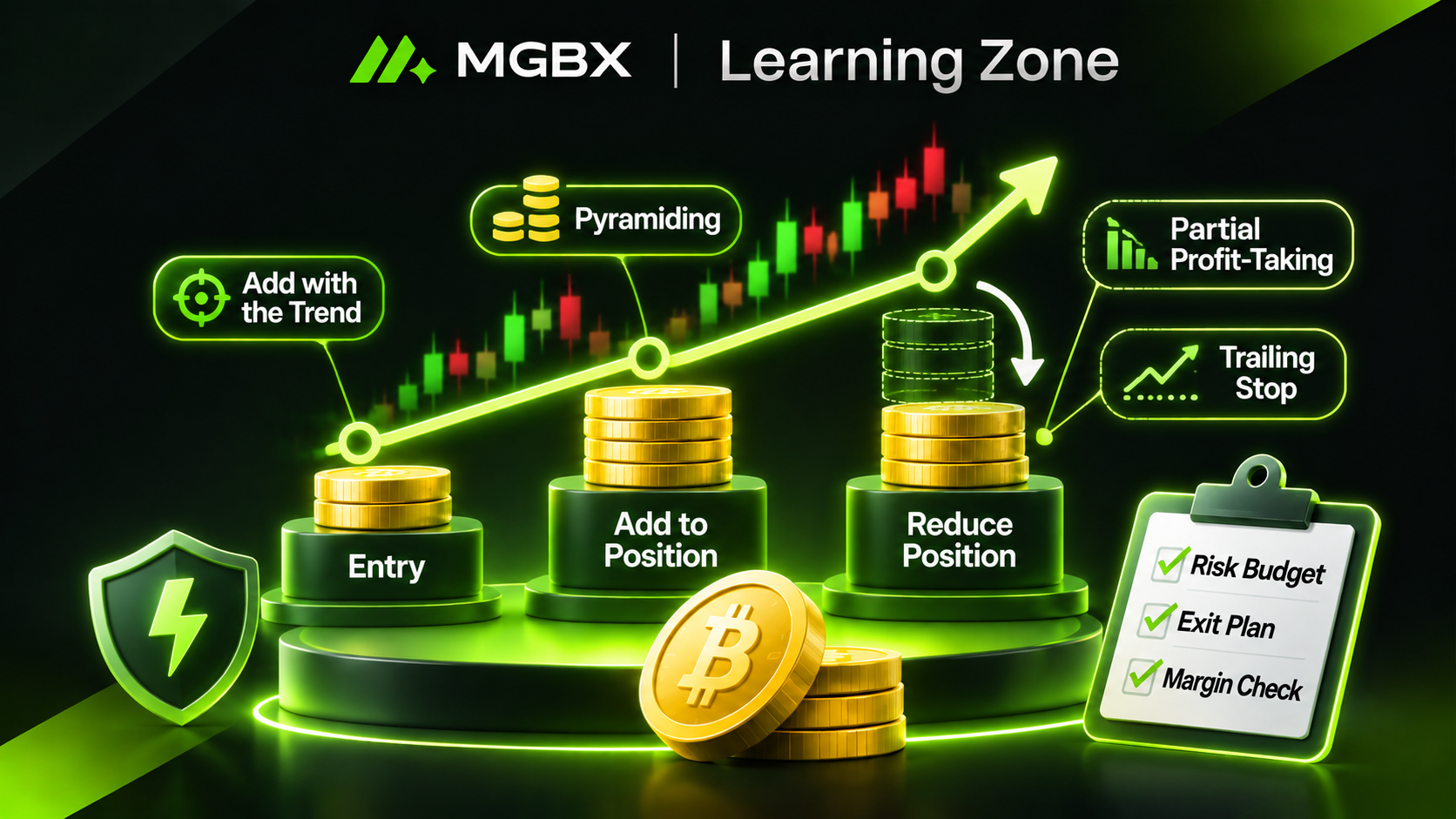
Adding to or reducing positions in a leverage strategy should depend on trade conditions and the combined risk budget. Trend-based additions, pyramiding, and partial profit-taking are position management methods, not guarantees of higher returns. Each adjustment requires recalculating average entry price, exit scenarios, margin requirements, and costs. Unrealized gains are not a permanent buffer, and trailing stops cannot guarantee breakeven. The goal is to keep exposure within the account’s risk capacity.
How Do Trend-Based Additions and Pyramiding Work?
Adding with the trend means increasing a position under predefined conditions after prices move in the anticipated direction.
Pyramiding typically involves progressively smaller additions. For a maximum position of 10 underlying units, entries might be split into 5, 3, and 2 units. This limits later additions but does not guarantee sufficient distance between the average entry price and the current price.
Existing unrealized profits do not prove that a trend will continue. Before adding, confirm the new portion’s exit level, combined loss budget, and margin requirements. Do not treat all floating profits as available risk capacity.
CME Group’s position and risk management guidance emphasizes sizing trades around risk scenarios rather than maximum permitted exposure. These entry proportions are educational examples, not an optimal allocation for every market.
How Do You Calculate Risk After Adding to a Position?
Consider a linear futures long: buy 10 units at 100, then add 5 at 110. The total is 15 units at an average entry price of approximately 103.33. If all units exit at 98, the original portion loses 20 and the addition loses 60, totaling 80 before fees.
Although the addition is half the original quantity, its greater distance from the exit contributes more potential loss. Measured against equity when adding, a decline from 110 to 98 also gives back 100 of existing unrealized profit, producing a total equity decline of approximately 180.
Assess both final profit or loss relative to entry cost and drawdown from current equity. If you adjust the exit, recheck its price reference, liquidation conditions, and allowance for slippage. For calculations, see Margin Explained.
When Should You Reduce Positions and Adjust Trailing Stops?
Reassess size when the trade thesis fails, volatility rises, holding costs increase, or correlated positions push total risk beyond budget. Scaling out reduces exposure while retaining part of the position, but may reduce gains if favorable moves continue. It is not universally optimal.
Trailing stops adjust exit triggers according to predefined rules but cannot guarantee profits. Even with a stop above the average entry price, fees, funding, price gaps, and slippage can worsen the outcome. A stop-limit order may trigger without filling.
After reducing a position, check remaining order quantities and reduce-only settings to prevent unintended exposure. Frequent adjustments without new information may simply increase costs. Define triggers, position limits, and conditions for stopping trading so each adjustment has a clear basis.
FAQ
Should you only add to profitable positions?
This is not a universal rule. Every addition needs clear conditions and a combined risk budget.Is pyramiding always safer than entering all at once?
No. Outcomes depend on entry prices, total quantity, exit conditions, and the price path.Does moving a stop to the entry price guarantee breakeven?
No. Fees, slippage, and execution affect the result.What if prices keep rising after scaling out?
That is the opportunity cost of reducing exposure. Evaluate the decision against your plan, not hindsight alone.
Mastering the basics is the first step. Follow MGBX Academy to access more cryptocurrency educational resources and market opportunities.
The process for trading on MGBX:
Register a trading account and complete the necessary identity verification;
Deposit funds and select a trade type;
On the cryptocurrency trading page, enter the amount or quantity of the cryptocurrency you wish to purchase;
Confirm the order to complete the trade, and check that your assets have increased accordingly.
Further Readings:
The Complete Beginner’s Guide to Leverage Trading
Adding Margin and Liquidation Alerts: Managing Extreme Market Conditions
Real-Life Leverage Liquidation Cases: Lessons from 100,000 to Zero
Margin Trading vs. Futures Trading: Differences and How to Choose
Long-Term Strategies with Low Leverage: Is Consistent Profit Possible?