Ethereum vs. Bitcoin: Key Differences
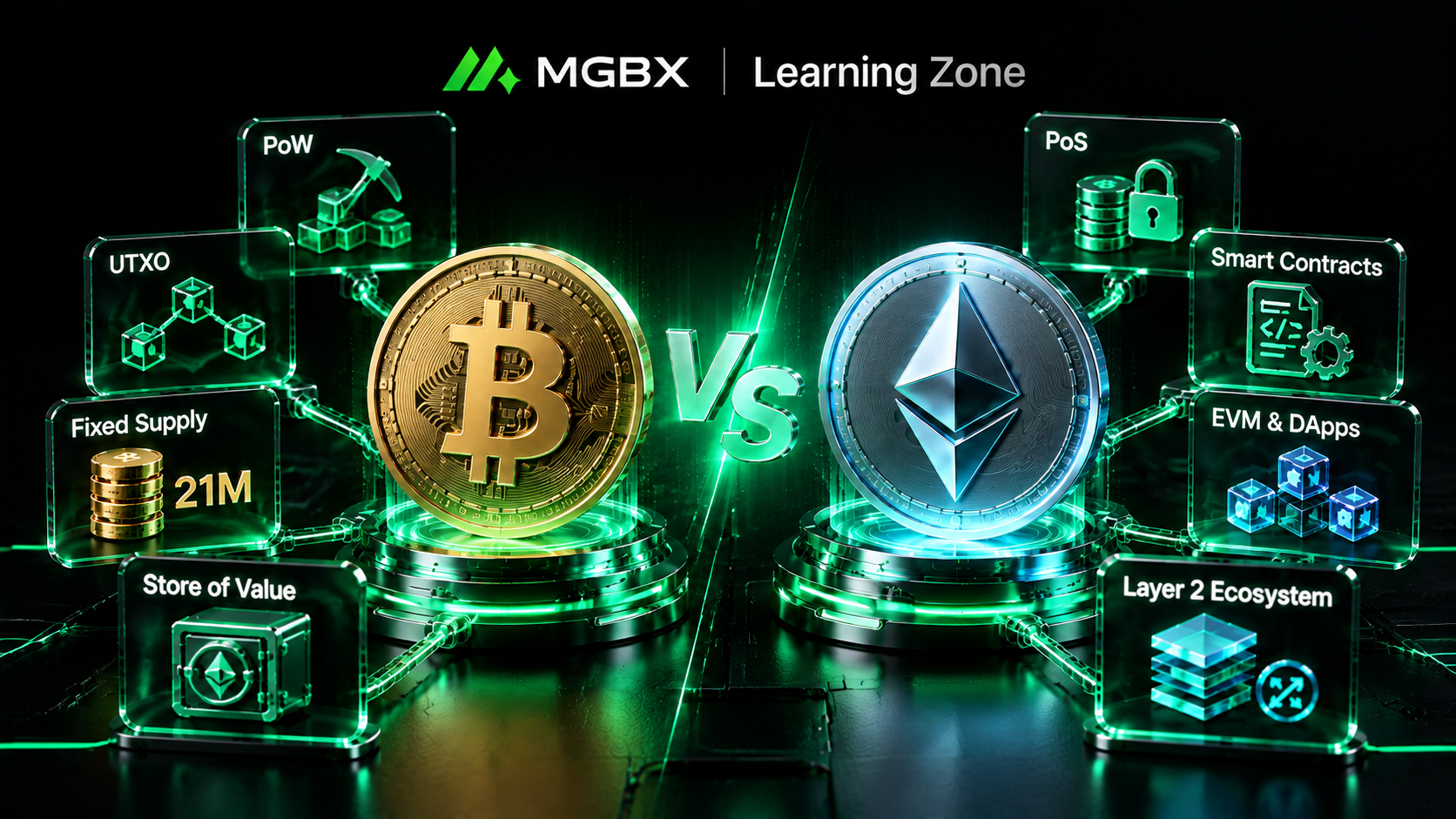
BTC and ETH are both major native assets of blockchain networks, but they serve different purposes. Bitcoin focuses on decentralized value transfer, censorship resistance, and predictable issuance, while Ethereum uses smart contracts, the EVM, and an account-based state model to provide programmable infrastructure for DeFi, stablecoins, NFTs, and Layer 2 networks. Understanding ETH vs. BTC is not about deciding which asset is universally better, but about recognizing how their technology, economic models, and use cases differ.
How Do the Design Goals of BTC and ETH Differ?
The Bitcoin whitepaper introduced a peer-to-peer electronic cash system designed to enable value transfers without relying on a trusted third party. Ethereum, by contrast, introduced smart contracts, allowing a blockchain to do more than record asset transfers. It can also execute programs and maintain a continuously updated network state.
As a result, BTC is primarily associated with decentralized money and value transfer, while ETH supports smart contract execution, DApp development, and settlement across the broader Ethereum ecosystem. The two are not simply examples of “old technology versus new technology,” but distinct blockchain infrastructures built around different design goals.
Technical Comparison: PoW, PoS, Account Models, and Transaction Structures
Bitcoin uses Proof of Work (PoW), in which miners contribute computing power to maintain the blockchain. Since 2022, Ethereum has used Proof of Stake (PoS), with validators staking ETH to participate in block proposals and validation. Ethereum's PoS network uses 12-second slots as its basic time unit, with validator attestations contributing to consensus.
Their transaction models also differ significantly. Bitcoin uses the UTXO model to track unspent transaction outputs, while Ethereum uses an account-based model and a global state. This allows Ethereum to use the EVM to execute smart contracts, with Gas pricing the computational resources required.
Supply and Use Cases: How Should You Understand ETH vs. BTC?
Bitcoin has a protocol-defined maximum supply of 21 million coins, with its halving mechanism gradually reducing the rate of new issuance. Ethereum does not have the same fixed supply cap. Its net supply is influenced by new ETH issuance under PoS and the EIP-1559 fee-burning mechanism, meaning its supply can increase or decrease over time.
In terms of use cases, Bitcoin's core narrative centers on value transfer, store of value, and digital asset allocation. Ethereum, meanwhile, has developed a broader smart contract ecosystem and increasingly relies on Rollups and Layer 2 networks to handle transaction execution. Different L2 networks have different proof systems, security models, and trust assumptions, so it is inaccurate to assume that every Layer 2 network has exactly the same security properties as Ethereum mainnet.
FAQ
-
What is the biggest difference between ETH and BTC?
BTC focuses primarily on decentralized money and value transfer, while ETH also provides infrastructure for smart contracts and programmable applications. -
Is BTC necessarily safer than ETH?
Not necessarily. Their consensus mechanisms, attack models, and system designs differ, so security should be evaluated in the context of specific use cases. -
Does ETH have a maximum supply of 21 million coins?
No. ETH's supply changes according to the balance between new issuance and the amount of ETH burned. -
Can BTC and ETH be stored in the same wallet?
Some multi-chain wallets support both assets, but their underlying networks and transaction models differ. Always verify the correct address, network, and asset type before transferring funds.
Mastering the basics is the first step. Follow MGBX Academy to access more cryptocurrency educational resources and market opportunities.
The process for trading on MGBX:
-
Register a trading account and complete the necessary identity verification;
-
Deposit funds and select a trade type;
-
On the cryptocurrency trading page, enter the amount or quantity of the cryptocurrency you wish to purchase;
-
Confirm the order to complete the trade, and check that your assets have increased accordingly.