Ethereum Technical Architecture: EVM, Gas, and the Account Model
Understand the EVM, Gas mechanism, and Ethereum account model in simple terms. Learn how smart contracts execute, how transaction fees are generated, and how an ETH transaction is completed.
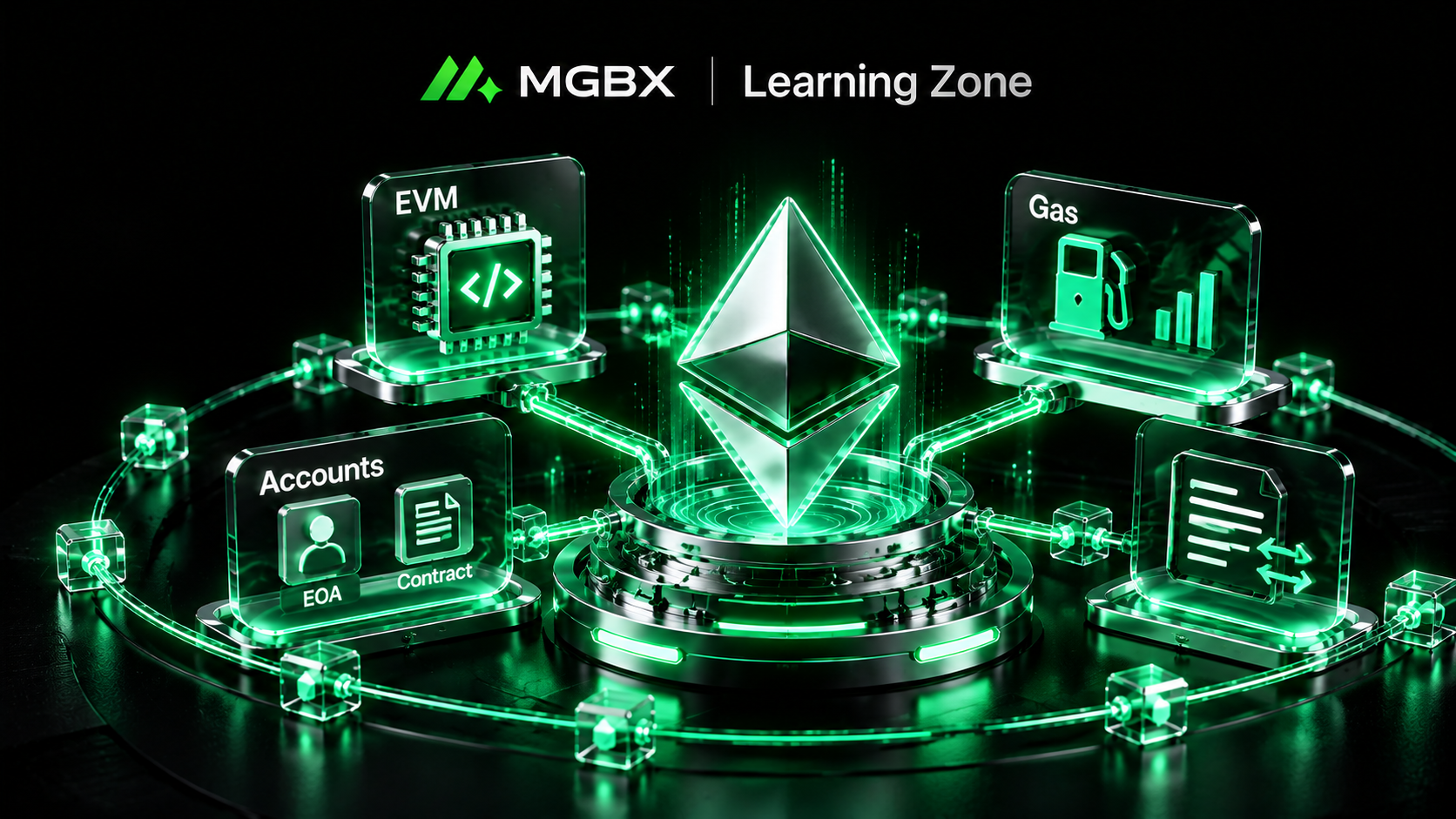
Ethereum can be understood as a state machine maintained collectively by nodes around the world: accounts hold assets and state, transactions trigger state changes, the EVM executes smart contract code, and Gas measures the computational resources consumed during execution. Understanding how the EVM, Gas mechanism, and Ethereum accounts work together provides the technical foundation needed to read Ethereum transactions, DApps, and on-chain data.
EVM: It Executes Code, Not Compiles It
If Ethereum is viewed as a distributed computer, the EVM (Ethereum Virtual Machine) can be understood as its standardized program execution environment.
Developers typically write smart contracts in high-level languages such as Solidity and then use a compiler to convert the source code into bytecode. Once deployed to the Ethereum network, this bytecode is executed by the EVM. Therefore, the common statement that “the EVM compiles Solidity into bytecode” is not technically accurate.
All nodes that follow the protocol rules perform computations according to the same EVM specification, ensuring that the same transaction produces deterministic state changes.
For example, when a transaction calls a token contract, the EVM executes the relevant function and updates the state of the associated accounts or contract.
Gas Mechanism: Pricing On-Chain Computational Resources
Executing code requires computational resources, so Ethereum uses the Gas mechanism to measure how much work different operations require.
A simple ETH transfer generally requires relatively little computation, while a complex smart contract call may involve multiple reads, calculations, and state updates, consuming more Gas. Users ultimately pay the associated fees in ETH.
Gas also plays an important role in network security. If on-chain programs could perform unlimited computations at no cost, attackers could potentially consume network resources indefinitely through mechanisms such as infinite loops. Gas sets a resource limit for each transaction, and execution stops when the available Gas runs out.
Since EIP-1559, Ethereum’s transaction fee mechanism has also included components such as the base fee. The base fee is burned, while validators can receive the priority fee, so it is inaccurate to think of the entire Gas fee simply as a “reward paid to validators.”
Ethereum Accounts: What Is the Difference Between EOAs and Contract Accounts?
Traditionally, Ethereum accounts have been divided into two main types.
EOAs (Externally Owned Accounts) are controlled by private keys, allowing users to sign and submit transactions through wallets. Contract accounts contain smart contract code and execute according to their programmed logic when they receive transactions or calls from other contracts.
This differs from the UTXO model commonly used by Bitcoin. Ethereum instead focuses on a global “state”: account balances, contract storage, and other data together represent the network’s current state, while transactions move the system from one state to another.
The 2025 Pectra upgrade introduced EIP-7702, allowing EOAs to authorize smart contract code and gain capabilities such as transaction batching and sponsored fees. This was an important step toward a more flexible account experience, although it does not mean that all differences between traditional EOAs and contract accounts have disappeared.
How Does an Ethereum Transaction Work?
Once these three concepts are connected, an Ethereum transaction becomes much easier to understand.
The user first signs and submits the transaction through an account;
After receiving the transaction, the network verifies it according to the protocol rules.
If the transaction calls a smart contract, the EVM executes the relevant bytecode. This process consumes Gas, and once execution is complete, the network state—including account balances and contract data—is updated.
The entire technical flow can therefore be summarized as:
Account authorizes transaction → Transaction enters the network → EVM executes code → Gas measures computational resource usage → Ethereum updates the network state.
Once this flow is clear, DeFi transactions, NFT minting, and interactions between Layer 2 networks and Ethereum mainnet become much easier to understand.
The EVM, Gas mechanism, and Ethereum accounts are not three separate concepts. They form an integrated system: accounts handle identity and state, transactions trigger operations, the EVM executes smart contracts, and Gas prices and limits the use of scarce computational resources. Mastering this framework is a key step from simply “knowing what ETH is” to truly understanding Ethereum’s technical architecture, while also providing a foundation for learning more about smart contracts and Layer 2.
Mastering the basics is the first step. Follow MGBX Academy to access more cryptocurrency educational resources and market opportunities.
The process for trading on MGBX:
Register a trading account and complete the necessary identity verification;
Deposit funds and select a trade type;
On the cryptocurrency trading page, enter the amount or quantity of the cryptocurrency you wish to purchase;
Confirm the order to complete the trade, and check that your assets have increased accordingly.