What Is Ethereum (ETH)? A Complete Guide to the World Computer
What is Ethereum? Learn the basics of ETH, smart contracts, EVM, Gas, DeFi, NFTs, and Layer 2 to build a complete understanding of Ethereum.
Ethereum is a public blockchain that supports smart contracts and decentralized applications, while ETH is its native asset. Unlike early blockchains that were primarily designed to record asset transfers, Ethereum brought “programmable computing” on-chain, allowing developers to build applications such as DeFi, NFTs, and DAOs. The term “world computer” is essentially a metaphor for a global network of nodes that execute programs, verify state, and maintain the same blockchain ledger according to a common set of rules.
What Is Ethereum? Why Is It Called the “World Computer”?
To understand what Ethereum is, it is important to first distinguish between Ethereum and ETH.
Ethereum is an open blockchain network, while ETH (Ether) is the network’s native crypto asset. Vitalik Buterin proposed the concept of Ethereum in 2013, and the network officially launched in July 2015. One of its key differences from early blockchains is that it can not only record asset transfers but also execute programs deployed by developers. This is why Ethereum is often called the “world computer.” It does not refer to a physical supercomputer somewhere in the world. Instead, it is a metaphor for nodes distributed across different regions that process transactions, execute code, and maintain a consistent network state according to the same protocol.
For ETH beginners, one simple relationship is worth remembering: Ethereum is the network, ETH is the asset, and smart contracts are programs that run on the network.
Smart Contracts: The Core of Ethereum’s Programmability
Smart contracts were not originally invented by Ethereum. Cryptographer Nick Szabo introduced the concept of Smart Contracts in the 1990s. Ethereum’s major innovation was to provide a general-purpose blockchain environment where smart contracts could be widely deployed and combined.
Simply put, a smart contract is a program that runs on the Ethereum blockchain. When a user submits a transaction and the required conditions are met, the network executes the operation according to the contract’s code. For example, decentralized exchange protocols can swap tokens based on predefined rules, lending protocols can manage collateral, and NFT contracts can record the issuance and transfer of tokens.
Smart contracts also make Ethereum a “programmable blockchain.” Developers do not need to build a separate blockchain for every application. Instead, they can use Ethereum’s shared infrastructure to create DApps.
Technical Architecture: How EVM, Gas, and ETH Keep the Network Running
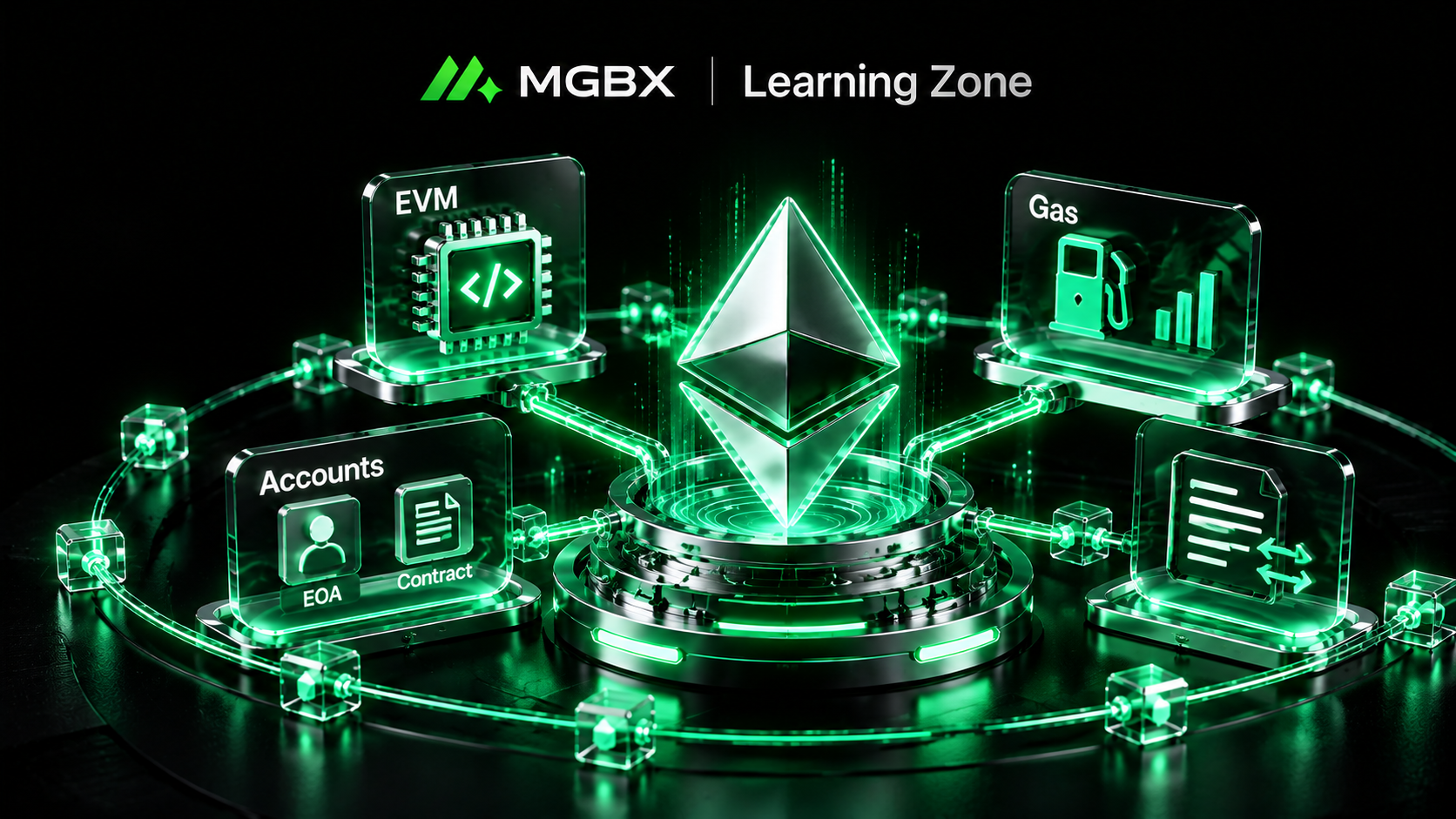
These smart contracts are primarily executed by the EVM (Ethereum Virtual Machine). Developers typically write programs in languages such as Solidity and then compile them into bytecode that the EVM can execute. Nodes across the network process this code according to the same EVM rules, producing consistent results.
Computation requires resources, so Ethereum uses the Gas mechanism to measure how much computational work a transaction requires. The transaction sender pays the associated fees in ETH. Gas also limits the amount of resources a single execution can consume, preventing issues such as infinite loops from continuously consuming network resources.
ETH has another core function: staking. Ethereum currently uses a Proof-of-Stake (PoS) consensus mechanism, with validators staking ETH to participate in block validation and help secure the network.
Therefore, ETH is more than a tradable digital asset. It also serves as the asset used to pay network fees, the asset used for staking, and a foundational asset across the Ethereum ecosystem.
From DeFi and NFTs to Layer 2: How the Ethereum Ecosystem Has Evolved
Smart contracts have helped create a complete Ethereum application ecosystem.
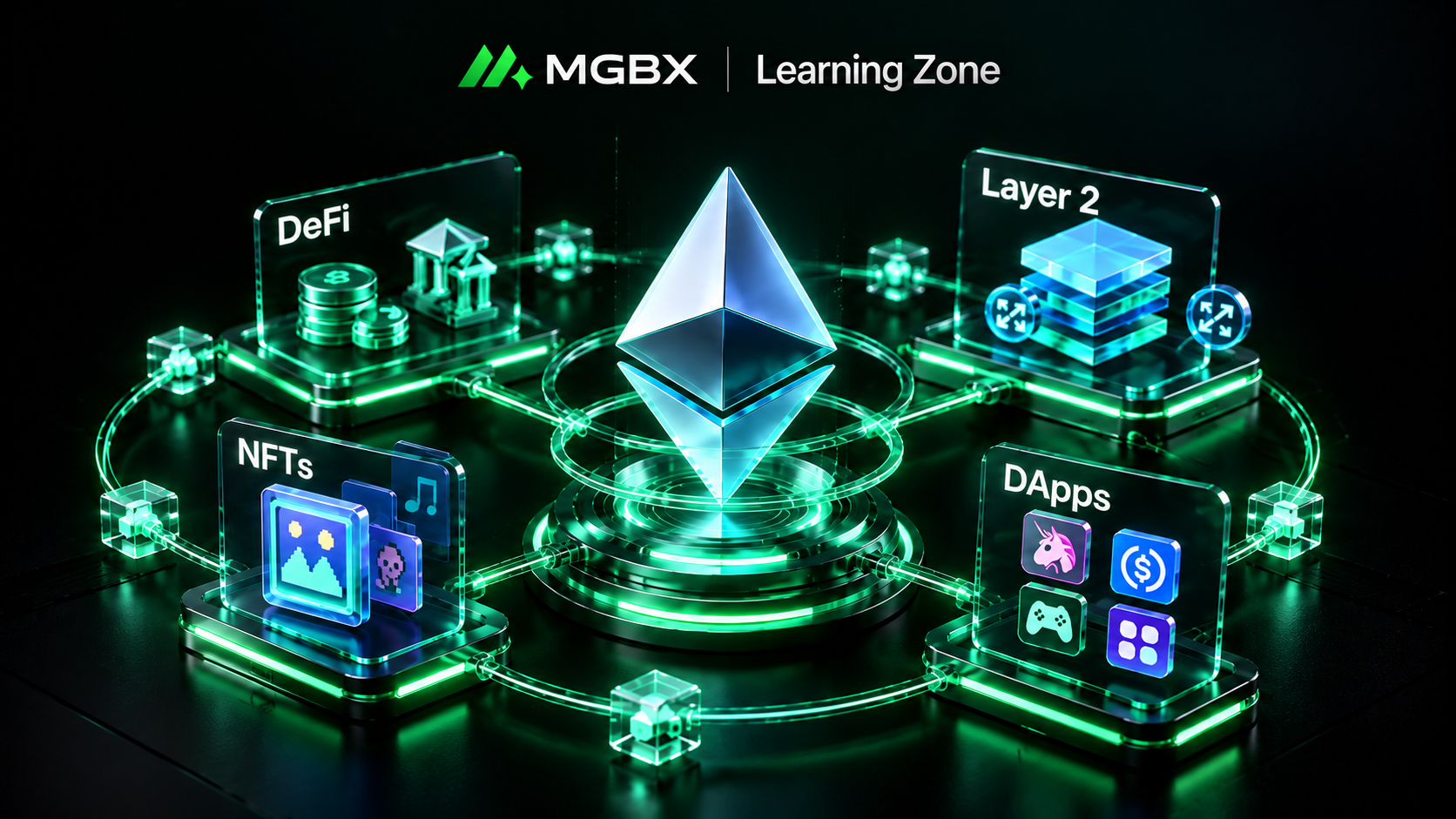
DeFi puts financial rules such as trading and lending into smart contracts. NFTs can represent on-chain assets with unique identifiers and attributes. Stablecoins provide tools for on-chain pricing and payments, while DAOs use smart contracts and governance rules to coordinate community decision-making.
As applications and transaction activity have grown, Ethereum has also developed a Layer 2 scaling ecosystem centered around Rollups. Layer 2 networks can process large numbers of transactions outside the mainnet and then submit relevant data, state commitments, or proofs to Ethereum. This reduces the need for users to directly consume Ethereum mainnet computation and data capacity. However, different Layer 2 networks have different security models and trust assumptions, so they should not simply be considered to have exactly the same security properties as Ethereum mainnet.
Ethereum can be understood through one simple chain of logic: ETH provides the network’s economic foundation, the EVM provides the execution environment, smart contracts provide programmable rules, and DeFi, NFTs, and Layer 2 make up its application and scaling ecosystem. This is the real reason Ethereum is often called the “world computer.” For users who have just learned the basics of ETH, the next step is to explore Ethereum’s history, smart contracts, the EVM, and other underlying mechanisms rather than viewing Ethereum solely through the market price of ETH.
Mastering the basics is the first step. Follow MGBX Academy to access more cryptocurrency educational resources and market opportunities.
The process for trading on MGBX:
Register a trading account and complete the necessary identity verification;
Deposit funds and select a trade type;
On the cryptocurrency trading page, enter the amount or quantity of the cryptocurrency you wish to purchase;
Confirm the order to complete the trade, and check that your assets have increased accordingly.