Ethereum Ecosystem Overview: DeFi, NFTs, and Layer 2
A complete guide to the ETH ecosystem, from DeFi and NFTs to Layer 2, explaining how smart contracts power a diverse range of Ethereum applications and a multi-layer scaling ecosystem.
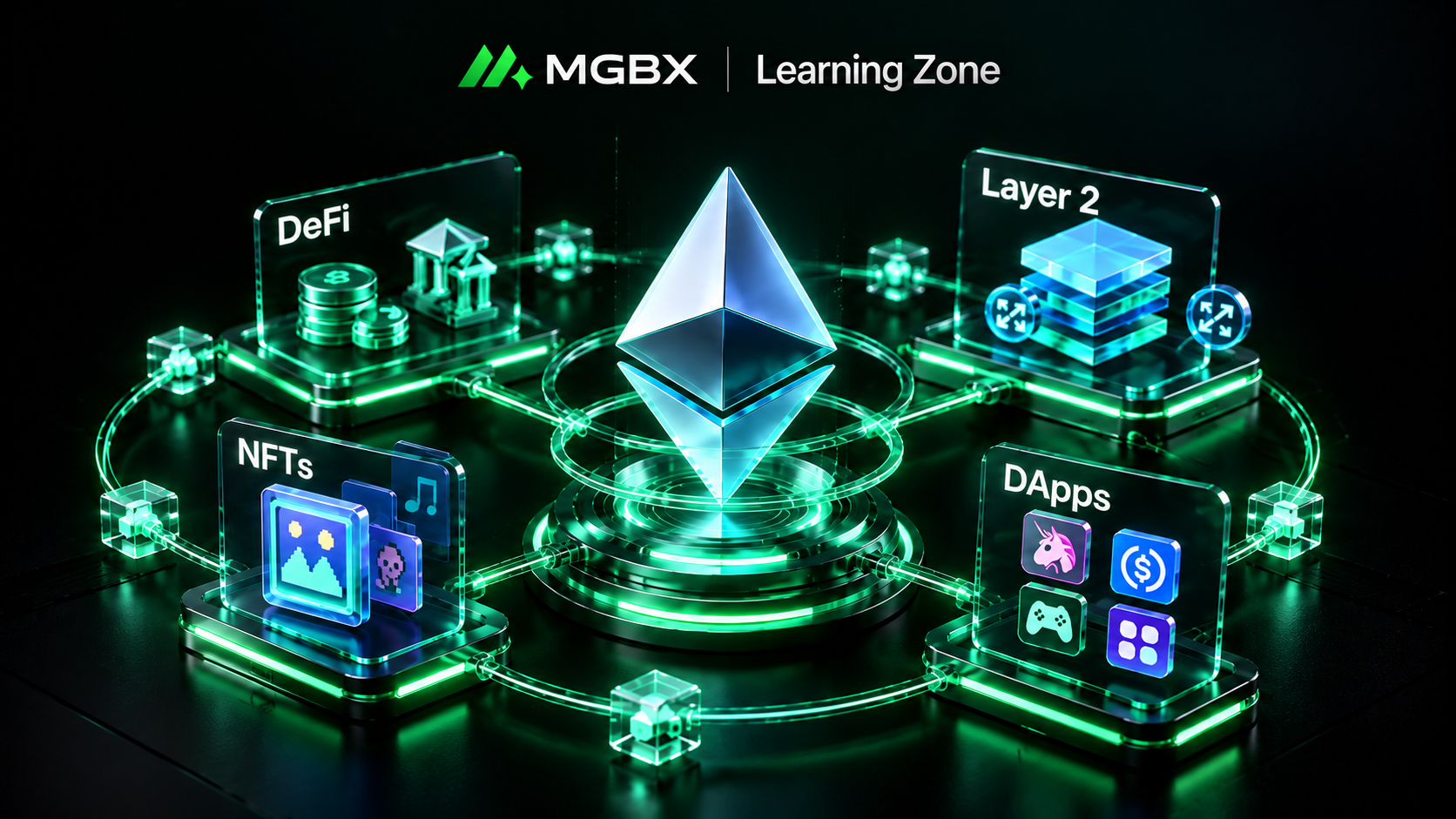
The ETH ecosystem is about much more than ETH itself. It is an interconnected network of applications built on Ethereum smart contracts, token standards, and Layer 2 networks. DeFi enables on-chain financial interactions, NFTs provide a way to represent non-fungible assets, while Layer 2 networks handle an increasing share of transaction execution and scaling. Together, these components show how Ethereum has evolved from a single blockchain into a multi-layer ecosystem made up of the mainnet, Layer 2 networks, and application protocols.
DeFi Ecosystem: How Smart Contracts Become “Financial Building Blocks”
The DeFi ecosystem is one of the most prominent application categories on Ethereum.
Rules for trading, lending, stablecoins, and asset management can be encoded into smart contracts, allowing users to interact directly with protocols through their wallets. More importantly, different contracts can interact with one another, enabling developers to combine existing protocols into new products. This composability is why DeFi is often described as “financial Lego.”
For example, a token can be supported by a trading protocol while also serving as collateral in a lending protocol. Another application can then build on the assets or credentials generated by these protocols. This composability accelerates innovation, but it also means that risks can spread across interconnected applications. If an underlying protocol, oracle, or smart contract encounters a problem, other applications that depend on it may also be affected. Therefore, “permissionless” in DeFi should not be interpreted as “risk-free.”
NFTs: On-Chain Ownership Records Do Not Equal Copyright
NFTs (Non-Fungible Tokens) address a different challenge: representing distinct digital objects on a blockchain.
Ethereum standards such as ERC-721 and ERC-1155 allow tokens to have unique identifiers and attributes, making NFTs useful for digital collectibles, in-game items, membership credentials, and other on-chain assets.
A common misconception is that NFTs make digital content “impossible to copy.” In reality, images and files can still be copied. NFTs primarily record the identity, ownership, and transfer history of a specific on-chain token. Whether purchasing an NFT also grants copyright, commercial rights, or other legal rights depends on the issuer’s terms and applicable laws.
Layer 2: Why Does Ethereum Need a Second Layer?
When large numbers of Ethereum applications compete for limited mainnet block space, network capacity constraints can drive up transaction costs. As a result, Ethereum’s current scaling roadmap relies heavily on Layer 2 networks, particularly Rollups.
Rollups typically execute large numbers of transactions outside the Ethereum mainnet and then submit relevant transaction data, state information, or validity proofs back to the mainnet. Optimistic Rollups and ZK Rollups use different verification approaches, but their core goal is similar: move more execution to Layer 2 while using Ethereum as an important settlement and data foundation.
Dencun introduced blobs, Pectra increased blob capacity, and Fusaka introduced PeerDAS in 2025, further strengthening Ethereum’s ability to provide data availability for Layer 2 networks.
However, different Layer 2 networks can have different trust assumptions involving proof systems, upgrade permissions, sequencers, and security committees. Therefore, it is not appropriate to broadly claim that all L2s “fully inherit” the security of the Ethereum mainnet. Ethereum’s official guidance likewise encourages users to understand the specific risks associated with each Layer 2.
The ETH Ecosystem: From a Single Chain to a Multi-Layer Network
Looking at the ETH ecosystem as a whole, its structure can be summarized as follows:
The Ethereum mainnet provides core consensus, settlement, and data infrastructure;
ETH supports economic mechanisms such as Gas payments and staking, while smart contracts provide the programmable layer;
DeFi, NFTs, stablecoins, and other DApps make up the application layer;
Layer 2 networks handle an increasing share of real-world transactions and user interactions.
Ethereum today is therefore better understood as a network ecosystem composed of L1 + Layer 2 + smart contracts + application protocols. This structure also reflects a major shift in Ethereum’s scaling strategy: rather than forcing every transaction onto the mainnet, Ethereum provides the security and settlement foundation while different Layer 2 networks handle a greater share of large-scale applications.
Mastering the basics is the first step. Follow MGBX Academy to access more cryptocurrency educational resources and market opportunities.
The process for trading on MGBX:
Register a trading account and complete the necessary identity verification;
Deposit funds and select a trade type;
On the cryptocurrency trading page, enter the amount or quantity of the cryptocurrency you wish to purchase;
Confirm the order to complete the trade, and check that your assets have increased accordingly.