ETH Investment Value and Risk Analysis
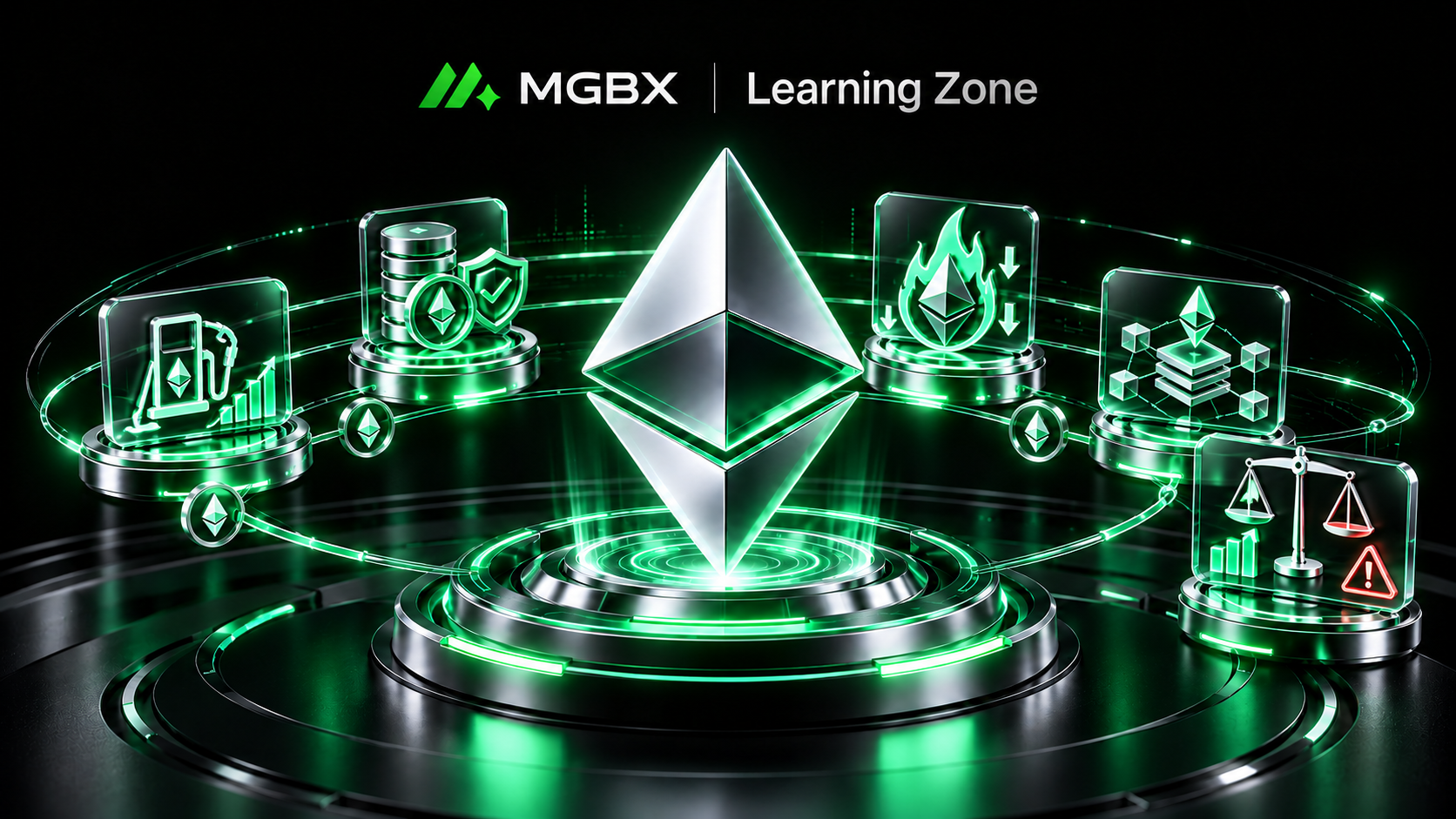
ETH derives its value from more than market price. Its fundamentals are also linked to Ethereum network usage, Gas fees, Proof-of-Stake (PoS) staking, and ecosystem growth. EIP-1559’s burn mechanism affects ETH supply, but does not mean ETH is permanently deflationary. Staking can generate protocol rewards, but these are neither fixed nor risk-free. ETH also faces price volatility, technical challenges, competition, regulatory uncertainty, and custody risks. Understanding these factors provides a more complete investment perspective than simply tracking price movements.
What Drives ETH’s Investment Value?
Ethereum is a blockchain network that supports smart contracts and decentralized applications (DApps), while ETH is its native asset. Users pay Gas fees when transferring assets or interacting with smart contracts on Ethereum. Validators also stake ETH to participate in Proof-of-Stake (PoS) consensus. As a result, ETH serves two fundamental purposes: facilitating network activity and helping secure the network.
ETH’s potential value is also linked to the growth of the Ethereum ecosystem. DeFi, stablecoins, NFTs, and Layer 2 networks are built on Ethereum or its broader scaling infrastructure. However, increased network activity does not necessarily mean that ETH’s price will rise. As more transactions move to Layer 2, ETH analysis should also consider mainnet settlement, data availability, and Layer 2 ecosystem activity rather than focusing solely on L1 transaction volume.
ETH Supply Dynamics and Staking Rewards
EIP-1559 introduced a mechanism that burns the Base Fee, while PoS issues ETH to validators as protocol rewards. Together, these mechanisms influence ETH’s net supply. When the amount of ETH burned exceeds new issuance, the supply may decrease; when issuance exceeds the amount burned, it may increase. Therefore, describing ETH as a “permanently deflationary asset” would be inaccurate.
Staking is another important use case for ETH. Running an independent validator currently requires at least 32 ETH. Users can also participate through staking pools and other services, although these options introduce additional risks related to smart contracts, service operators, or custody arrangements. Staking rewards are protocol incentives, not fixed interest rates in the traditional financial sense.
ETH Risks: Price Volatility, Technology, and Regulation
ETH is a highly volatile asset. Beyond market price fluctuations, investors should consider smart contract vulnerabilities, infrastructure security, competition from Layer 2 networks and other blockchains, and changes in the regulatory and custody environment. The SEC’s investor education materials also highlight risks associated with digital asset volatility, liquidity, cybersecurity, trading platforms, and fraud.
For this reason, ETH investment analysis is best approached through a “value drivers + risk factors” framework. Metrics such as Gas usage, ETH burns, staking participation, and Layer 2 activity can provide useful research insights, but none can reliably predict ETH’s price on its own. When trading through platforms such as MGBX, investors should also distinguish between spot and derivatives risks and avoid treating highly leveraged trading as a long-term investment strategy.
FAQ
-
What are the main drivers of ETH’s investment value?
ETH’s value is linked to Ethereum network usage, Gas payments, PoS staking, and ecosystem settlement demand, but these factors do not guarantee that its price will rise. -
Is ETH a deflationary asset?
Not necessarily. ETH’s net supply depends on the balance between new issuance and the amount burned through EIP-1559. -
Are ETH staking rewards fixed?
No. Actual rewards depend on network parameters, validator performance, staking methods, and applicable fees or penalties. -
What are the main risks of investing in ETH?
Key risks include price volatility, technical and smart contract vulnerabilities, competition, regulatory changes, custody risks, and trading platform risks.
Mastering the basics is the first step. Follow MGBX Academy to access more cryptocurrency educational resources and market opportunities.
The process for trading on MGBX:
-
Register a trading account and complete the necessary identity verification;
-
Deposit funds and select a trade type;
-
On the cryptocurrency trading page, enter the amount or quantity of the cryptocurrency you wish to purchase;
-
Confirm the order to complete the trade, and check that your assets have increased accordingly.