Stablecoins vs Bitcoin: What Are the Key Differences, Uses, and Risks?
What is the difference between stablecoins and Bitcoin? Compare USDT, USDC, and BTC by price mechanism, supply, issuance, use cases, and risk.
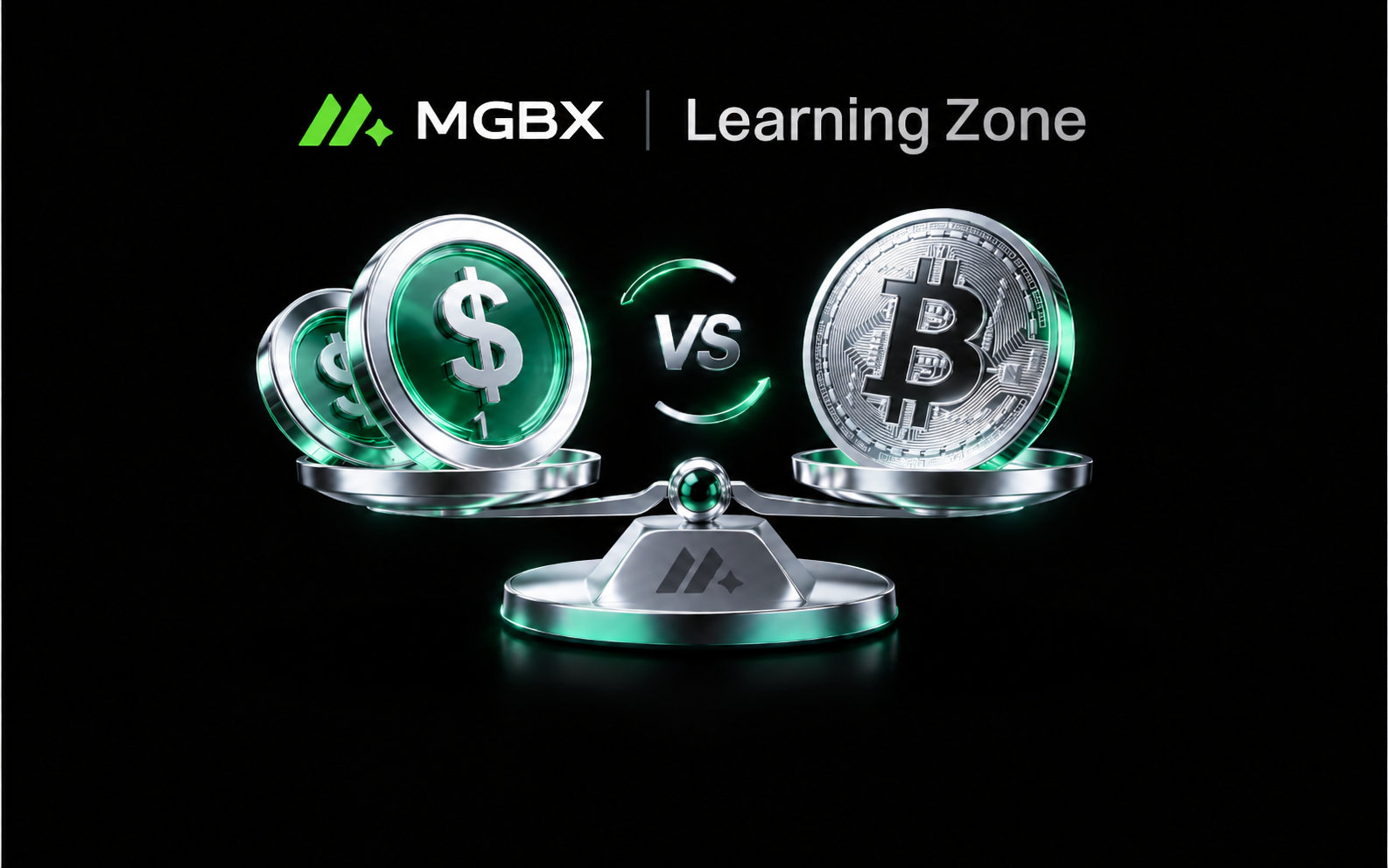
The biggest difference between stablecoins and Bitcoin lies in their price mechanisms and design goals. Bitcoin has no mechanism designed to maintain a fixed U.S. dollar value, so its market price is primarily determined by supply and demand. U.S. dollar stablecoins, by contrast, use reserves, issuance and redemption mechanisms, or other structures to try to keep their market value close to $1. Stablecoins are therefore commonly used for trading, pricing, and settlement, while BTC is an independently priced digital asset. Both carry risks, but those risks come from different sources.
What Is the Biggest Difference Between Stablecoins and Bitcoin?
Bitcoin has its own blockchain, consensus mechanism, and supply rules. Its U.S. dollar price is not pegged to a fixed value and is primarily determined by market supply and demand. Bitcoin’s protocol has a predefined supply limit, with new BTC entering circulation through block rewards. These rewards are reduced every 210,000 blocks through the Bitcoin halving, with the total supply ultimately approaching 21 million BTC.
Stablecoins have a different design objective. They generally aim to track the value of a reference asset such as the U.S. dollar. For example, USDC is designed to maintain a value close to the U.S. dollar, and Circle states that eligible customers can redeem USDC for U.S. dollars on a 1:1 basis and that the token is backed by highly liquid, dollar-denominated reserve assets.
How Do Their Value Mechanisms Differ?
Bitcoin has no central issuer that promises to redeem BTC at a fixed U.S. dollar value, so its dollar price can rise or fall significantly according to global market demand. Stablecoins typically use reserves, collateral, issuance and redemption processes, market arbitrage, or other mechanisms to maintain their peg. The specific model can vary substantially from one stablecoin to another.
For USDC, Circle publishes information about its reserves, including cash, short-term U.S. Treasuries, and other highly liquid reserve assets. This structure applies specifically to USDC and should not be assumed to represent how every stablecoin is backed.
When evaluating a stablecoin, users should therefore look beyond whether its market price is close to $1 and consider the issuer, reserve assets, redemption rules, smart contracts, and blockchain networks involved. Stablecoins can differ significantly in both centralization and risk structure.
How Do Stablecoins and Bitcoin Differ in Use Cases and Risk?
Stablecoins are widely used for crypto trading pairs, on-chain transfers, settlement, and DeFi because they are designed to reduce price volatility relative to a reference currency. Bitcoin, by contrast, is a freely priced digital asset that can be held, transferred, and traded, but its U.S. dollar value can fluctuate significantly.
The word “stable” does not mean risk-free. Even reserve-backed stablecoins may face issuer risk, reserve-asset risk, redemption pressure, market liquidity risk, depegging risk, and smart contract risk. BTC has a different risk profile that includes market-price volatility, network fees, custody risk, and private-key management. As a result, neither “stablecoins are always safer than Bitcoin” nor “Bitcoin is always a better asset to hold” is an accurate general conclusion. The more appropriate comparison depends on the user’s intended use and risk tolerance.
FAQ
Are stablecoins the same as Bitcoin?
No. Bitcoin is the native asset of an independent blockchain, while stablecoins are generally designed to track the price of a reference asset such as the U.S. dollar. Their issuance and pricing mechanisms are different.Are stablecoins always worth $1?
No. U.S. dollar stablecoins generally target a price close to $1, but liquidity conditions, reserve concerns, redemption demand, or changes in market confidence can cause temporary or prolonged deviations from the peg.Why is Bitcoin more volatile than U.S. dollar stablecoins?
BTC has no fixed dollar redemption or peg mechanism, so its price is primarily determined by market supply and demand. Stablecoins use specific mechanisms designed to limit price fluctuations relative to their reference asset.Do USDT, USDC, and other stablecoins work the same way?
No. Stablecoins may differ in issuer structure, reserve assets, collateral models, redemption rules, and smart contract design, so each should be assessed separately.Are stablecoins always safer than Bitcoin?
Not necessarily. Stablecoins generally reduce price volatility relative to a reference currency but introduce issuer, reserve, and depegging risks. Bitcoin carries a different set of risks, including price volatility, custody, and network-related risks.
Mastering the basics is the first step. Follow MGBX Academy to access more cryptocurrency educational resources and market opportunities.
The process for trading on MGBX:
Register a trading account and complete the necessary identity verification;
Deposit funds and select a trade type;
On the cryptocurrency trading page, enter the amount or quantity of the cryptocurrency you wish to purchase;
Confirm the order to complete the trade, and check that your assets have increased accordingly.