Leverage Risk Explained: Why High Leverage Can Amplify Trading Risks
Understand crypto leverage risks, including the dangers of high leverage, liquidation distance, and risk management strategies for futures trading.
Leverage trading is a common tool in the cryptocurrency market that can improve capital efficiency, but it also magnifies potential losses. Many traders focus on the profit amplification effect of leverage while overlooking how high leverage reduces account tolerance and makes normal market fluctuations more likely to trigger liquidation. This article explains how crypto leverage works, the risks of excessive leverage, factors affecting liquidation distance, and how to use leverage rationally to build a more disciplined futures trading risk management framework.
What Is Leverage Trading?
Leverage trading refers to a trading method where traders use margin to control a larger position with a smaller amount of capital. In the cryptocurrency market, leverage is commonly used in derivatives products such as perpetual futures, allowing traders to increase capital efficiency.
For example, if a trader has 1,000 USDT in margin and uses 10x leverage to trade BTC, they can theoretically control a position worth approximately 10,000 USDT.
If BTC rises by 5%:
10,000 USDT × 5% = 500 USDT
Compared with the 1,000 USDT margin, the return is approximately 50%.
However, if BTC falls by 5%, the trader also faces a loss of around 500 USDT, meaning the account loses 50% of the initial margin.
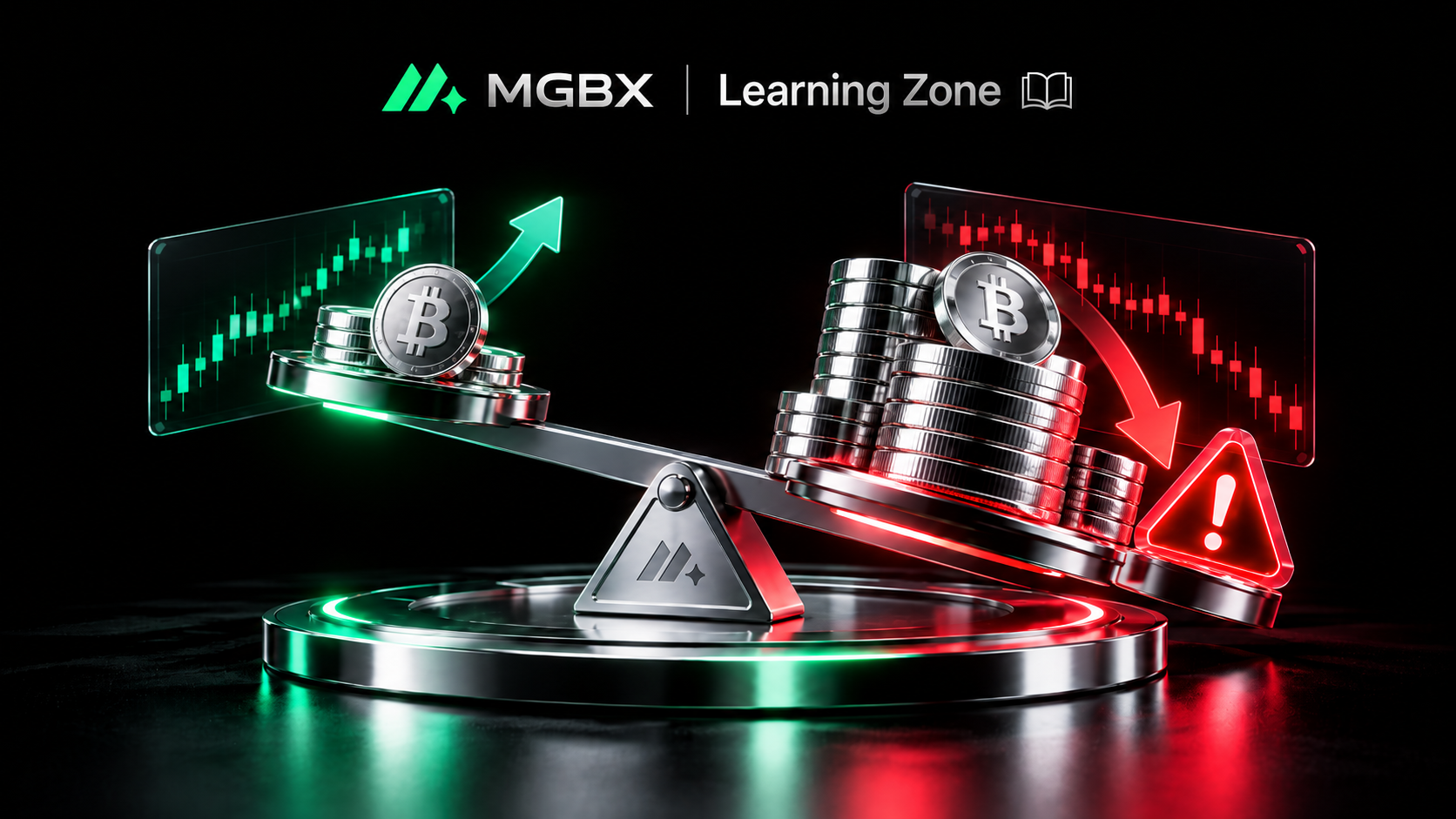
This is the core characteristic of leverage trading: Leverage does not increase trading accuracy or reduce market risk. It only amplifies the outcome of a trade.
In the cryptocurrency market, BTC, ETH, and other digital assets already experience significant price volatility. High leverage further reduces a trader’s tolerance for market fluctuations. A normal price correction can quickly become a serious account risk.
Therefore, the biggest risk of leverage is not that the market will always move in the wrong direction, but that traders may not have enough time or margin to adjust their positions once the trade moves against them.
Main Risks of High Leverage: Liquidation Distance and Margin Pressure
One of the most important risk concepts in leveraged trading is liquidation distance.
Liquidation distance refers to the gap between the current market price and the forced liquidation price. Generally, the higher the leverage ratio, the closer the liquidation price is to the entry price, leaving less room for normal market fluctuations.
Assume a trader uses 10x leverage to go long on BTC:
Margin: 1,000 USDT
Controlled position: 10,000 USDT
If BTC declines by approximately 10%, the theoretical loss approaches 1,000 USDT, creating significant margin pressure.
With 20x leverage, the same level of market movement would consume available margin much faster.
It is important to note that the actual liquidation price is not calculated solely based on leverage. Trading platforms typically also consider:
Maintenance margin requirements;
Opening and closing fees;
Funding rate changes;
Market volatility and price movement speed.
Therefore, the actual liquidation distance is usually smaller than the theoretical calculation.
Besides liquidation risk, high leverage also introduces liquidity risks. During periods of rapid market movement, sudden price spikes, wider spreads, or reduced market depth may prevent traders from exiting positions at expected prices.
Why Does High Leverage Affect Trading Decisions?
Leverage risk is not only financial; it also affects trader psychology.
When position sizes become too large, even small price movements can create significant profit and loss changes. This often causes traders to make emotional decisions.
Common behaviors include:
Adding more positions after losses;
Increasing leverage to recover losses;
Expanding positions after profits;
Frequently changing trading plans.
For example, a trader using 50x leverage on BTC may experience significant account fluctuations from only a 1%-2% market movement. This high-pressure environment can cause traders to abandon their original risk management rules.
From a behavioral finance perspective, high leverage can amplify loss aversion. When losses increase rapidly, traders may choose to wait for a recovery instead of following their original stop-loss plan.
Therefore, excessive leverage not only increases financial risk but can also weaken trading discipline.
Using Leverage Rationally: Building a Futures Risk Management Framework
Leverage itself is not the problem. The key is whether it is used appropriately.
For most traders, leverage should support a trading strategy rather than become a tool for chasing excessive returns.
Rational leverage management requires attention to the following:
Choose leverage based on risk, not profit expectations. Traders should first determine: How much can they afford to lose? Where is the stop-loss level? What is the appropriate position size? Only after these factors are defined should leverage be considered.
Control actual position size. Even if a platform offers high leverage options, traders do not need to use maximum position capacity. Lower actual exposure provides more room for market fluctuations.
Set clear stop-loss rules. Stop losses are even more important in leveraged trading than in spot trading. A high-leverage position without a stop-loss plan can suffer significant losses from a single rapid market movement.
Choose an appropriate margin mode. Isolated Margin limits the risk of an individual position and prevents one trade from affecting the entire account. Cross Margin can improve capital efficiency but may also expose the overall account to greater risk.
Avoid holding highly leveraged positions for extended periods. Perpetual futures involve not only price risk but also funding rate costs. Long-term leveraged positions require careful evaluation of both market direction and trading expenses.
FAQ
Does higher leverage always mean higher returns?
No. Leverage amplifies both profits and losses, but it does not improve trading accuracy. If the market moves against the position, high leverage can quickly result in significant losses or liquidation.What is liquidation distance and why is it important?
Liquidation distance is the gap between the current market price and the forced liquidation price. A smaller distance means the account is more vulnerable to short-term price movements.How much leverage should beginners use?
There is no fixed standard. The appropriate leverage depends on trading experience, strategy, and risk tolerance. Beginners should generally avoid excessive leverage and focus on learning position management first.Does reducing leverage mean reducing profit opportunities?
Lower leverage reduces the amplification effect of returns, but it also reduces the risk of major losses and improves long-term trading stability.How can traders reduce leverage risks in futures trading?
Traders can manage leverage risks by controlling position size, setting stop losses, choosing appropriate margin modes, using lower leverage ratios, and maintaining sufficient margin buffers.
Mastering the basics is the first step. Follow MGBX Academy to access more cryptocurrency educational resources and market opportunities.
The process for trading on MGBX:
Register a trading account and complete the necessary identity verification;
Deposit funds and select a trade type;
On the cryptocurrency trading page, enter the amount or quantity of the cryptocurrency you wish to purchase;
Confirm the order to complete the trade, and check that your assets have increased accordingly.
Further Readings:
Complete Guide to Crypto Trading Risk Management
Risk-Reward Ratio Calculation: A Must-Do Step Before Every Trade
What Is the Kelly Criterion? Applications in Crypto Trading and Position Management