How to Set a Reasonable Risk Limit Per Trade
Learn how to set a reasonable risk limit per trade in crypto trading, including capital management, loss control, and position sizing strategies.
In cryptocurrency trading, controlling risk per trade is essential for long-term trading stability. Regardless of a strategy’s win rate, excessive losses from a single trade can lead to severe drawdowns that are difficult to recover from. Setting a reasonable risk limit allows traders to define their maximum acceptable loss in advance and calculate appropriate position sizes based on stop-loss distance. This article explains the concept of risk per trade, calculation methods, dynamic adjustment strategies, and how to integrate risk control into a personal trading framework.
What Is Risk Per Trade: The Foundation of Capital Management
Risk per trade refers to the maximum amount of capital or percentage of an account that a trader is willing to lose on a single trade. It does not represent how much capital is invested, but rather how much the account could lose if the trade moves against expectations and triggers a stop loss.
In the cryptocurrency market, price movements can happen quickly. BTC, ETH, and other digital assets may experience significant volatility due to market sentiment, macroeconomic events, liquidity changes, and other external factors. Even experienced traders with mature analysis methods cannot avoid every losing trade. Therefore, effective risk management is not about increasing the accuracy of every trade, but about limiting the impact of incorrect decisions on overall capital.
Many traders confuse position size with actual risk. For example, having 10,000 USDT in an account does not mean every trade should use the full 10,000 USDT. The key question is how much the account could realistically lose if the market moves against the position.
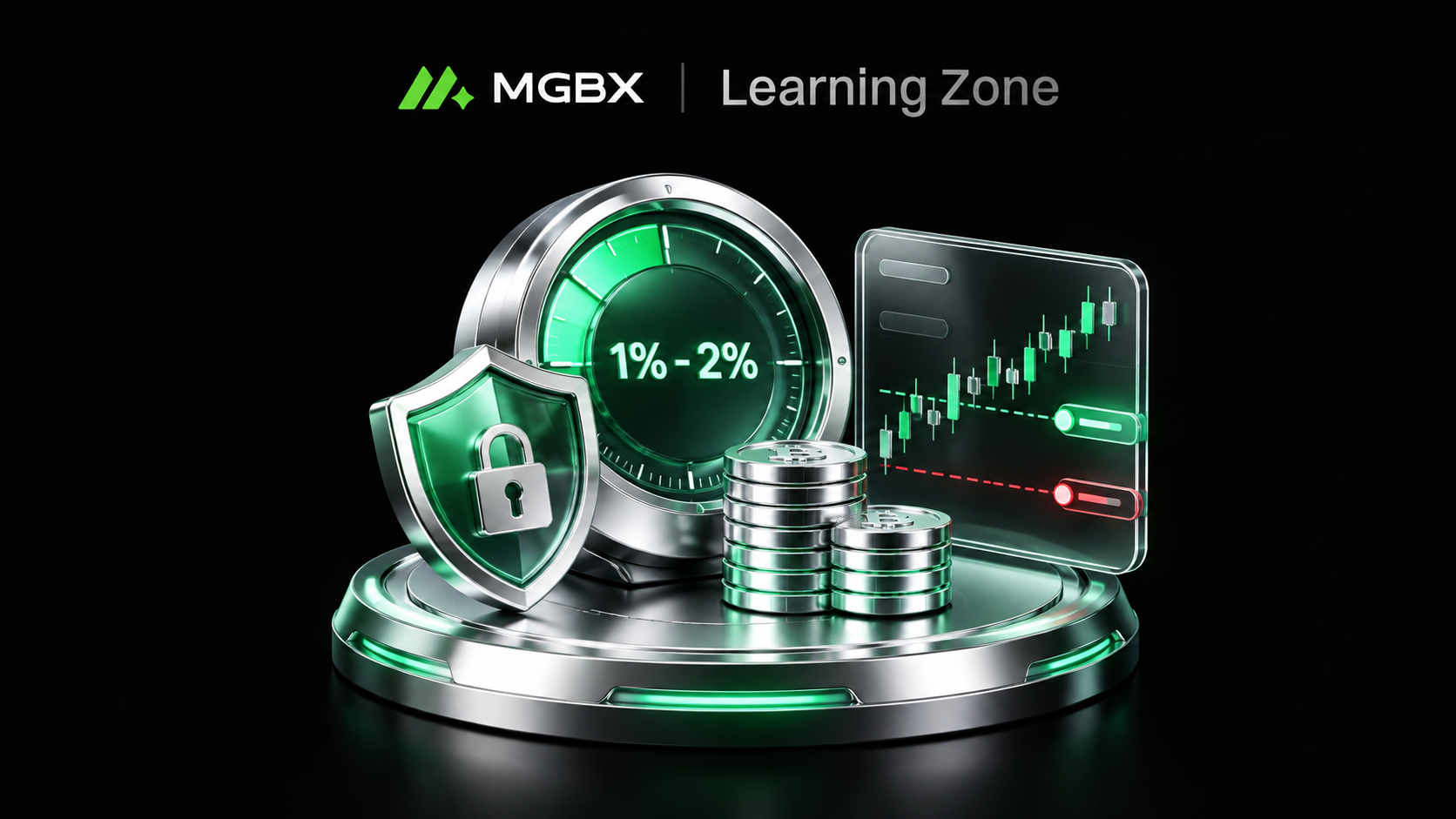
The purpose of setting a risk limit per trade is to ensure that traders can continue operating even after a series of losses. For example, if each trade is limited to 1%-2% of total account capital, multiple losing trades are less likely to cause severe damage to the account.
Risk Per Trade: Calculating Position Size Based on Maximum Loss
Professional traders usually do not decide how much to buy first. Instead, they determine the maximum acceptable loss and then calculate the appropriate position size based on the stop-loss distance.
The common calculation formula is:
Maximum risk per trade = Account balance × Risk percentage
For example, suppose a trader has 20,000 USDT in account capital and wants to limit each trade risk to 1%.
Maximum risk per trade:
20,000 USDT × 1% = 200 USDT
This means that regardless of whether the trade involves BTC, ETH, or another cryptocurrency, the trader aims to limit the maximum loss of this position to 200 USDT.
After determining the risk amount, the trader can calculate the position size based on the stop-loss distance:
Position size = Maximum risk per trade ÷ Stop-loss percentage
Assume the trader plans to buy BTC:
Entry Price: 100,000 USDT
Stop-Loss Price: 95,000 USDT
Stop-loss distance: (100,000 - 95,000) ÷ 100,000 = 5%
Therefore:
Position size = 200 USDT ÷ 5% = 4,000 USDT
This means that even with a 20,000 USDT account, the trader should not allocate the entire balance to this trade. Instead, the position size should be determined based on the predefined risk limit.
The main advantage of this approach is that position size automatically adapts to market conditions. When volatility increases and stop-loss distances become wider, position sizes naturally decrease. When volatility declines, traders can adjust capital allocation according to their strategy.
How to Determine the Right Risk Percentage Per Trade?
There is no universal risk percentage that applies to every trader. The appropriate risk level depends on trading experience, strategy type, and individual risk tolerance.
In trading, the 1%-2% risk rule is one of the most commonly used capital management approaches:
1% Risk: Suitable for traders who prioritize lower account volatility and long-term stability.
2% Risk: Suitable for traders who already have a structured trading system and can tolerate moderate drawdowns.
Higher Risk Percentage: Usually requires more mature strategies and stronger execution discipline. Otherwise, it may amplify emotional decision-making and increase account risk.
For beginner traders, a lower risk percentage is generally more appropriate. Limited trading experience combined with consecutive losses can negatively affect decision-making and lead to irrational behaviors such as increasing positions or chasing trades.
Risk per trade should also be adjusted based on market conditions.
High-volatility markets: Reduce risk per trade to avoid rapid account drawdowns during extreme price movements.
Range-bound markets: Reduce trading frequency to avoid capital erosion from repeated false signals.
During consecutive losses: Lower risk exposure and prioritize restoring trading discipline.
Experienced traders focus less on how much one trade can make and more on whether the account can achieve stable growth over many trades.
Risk Per Trade Should Be Combined with Stop Loss, Leverage, and Overall Risk Management
Risk control per trade does not work independently. It should be combined with stop-loss strategies and position management.
If a trader only sets a stop loss but ignores position size, the actual loss may still exceed the account’s acceptable risk level. For example, even with a 5% stop-loss setting, an oversized position can create an excessive financial impact.
For perpetual futures traders, risk management requires even greater attention because leverage amplifies price movements.
Traders should consider:
Maximum loss per trade;
Leverage ratio;
Margin requirements;
Liquidation distance;
Funding rate costs.
A reasonable trading process should be:
Determine the maximum loss the account can tolerate;
Calculate position size based on the stop-loss level;
Decide whether leverage is appropriate.
Traders should also monitor the risks caused by consecutive losses. Increasing position sizes in an attempt to recover losses quickly often leads to greater exposure and emotional trading. Instead, reducing risk exposure and reassessing the trading strategy is usually the more disciplined approach.
The ultimate goal of risk management is not to limit profit potential, but to improve long-term account survival.
FAQ
What is a reasonable risk limit per trade?
There is no fixed standard. Many traders limit risk per trade to around 1%-2% of total account capital, but the appropriate percentage depends on trading strategy, experience, and risk tolerance.Does lower risk per trade mean lower returns?
In the short term, lower risk may reduce potential gains from individual trades. However, over the long term, proper risk control can reduce major losses and improve the ability to continue trading.Can a high-win-rate strategy justify higher risk per trade?
Not necessarily. Even high-win-rate strategies can experience losing streaks. Risk should be evaluated together with profit-loss ratio, maximum drawdown, and historical performance.What is the difference between risk per trade and position size?
Risk per trade represents the maximum amount that can be lost, while position size represents the amount of capital allocated to the trade. Position size should be calculated based on risk amount and stop-loss distance.How should risk per trade be managed in perpetual futures trading?
Futures trading requires additional consideration of leverage and liquidation risk. Traders should determine their maximum acceptable loss first, then calculate position size instead of opening positions based only on available account balance.
Mastering the basics is the first step. Follow MGBX Academy to access more cryptocurrency educational resources and market opportunities.
The process for trading on MGBX:
Register a trading account and complete the necessary identity verification;
Deposit funds and select a trade type;
On the cryptocurrency trading page, enter the amount or quantity of the cryptocurrency you wish to purchase;
Confirm the order to complete the trade, and check that your assets have increased accordingly.
Further Readings:
Complete Guide to Crypto Trading Risk Management
Risk-Reward Ratio Calculation: A Must-Do Step Before Every Trade
What Is the Kelly Criterion? Applications in Crypto Trading and Position Management
Leverage Risk Explained: Why High Leverage Can Amplify Trading Risks