The Next Generation of Web3 Wallets: MPC Wallets and AA Smart Contract Wallets
Learn how MPC wallets, Account Abstraction, ERC-4337, and smart wallets work, and how next-generation Web3 wallets aim to improve security and user experience.
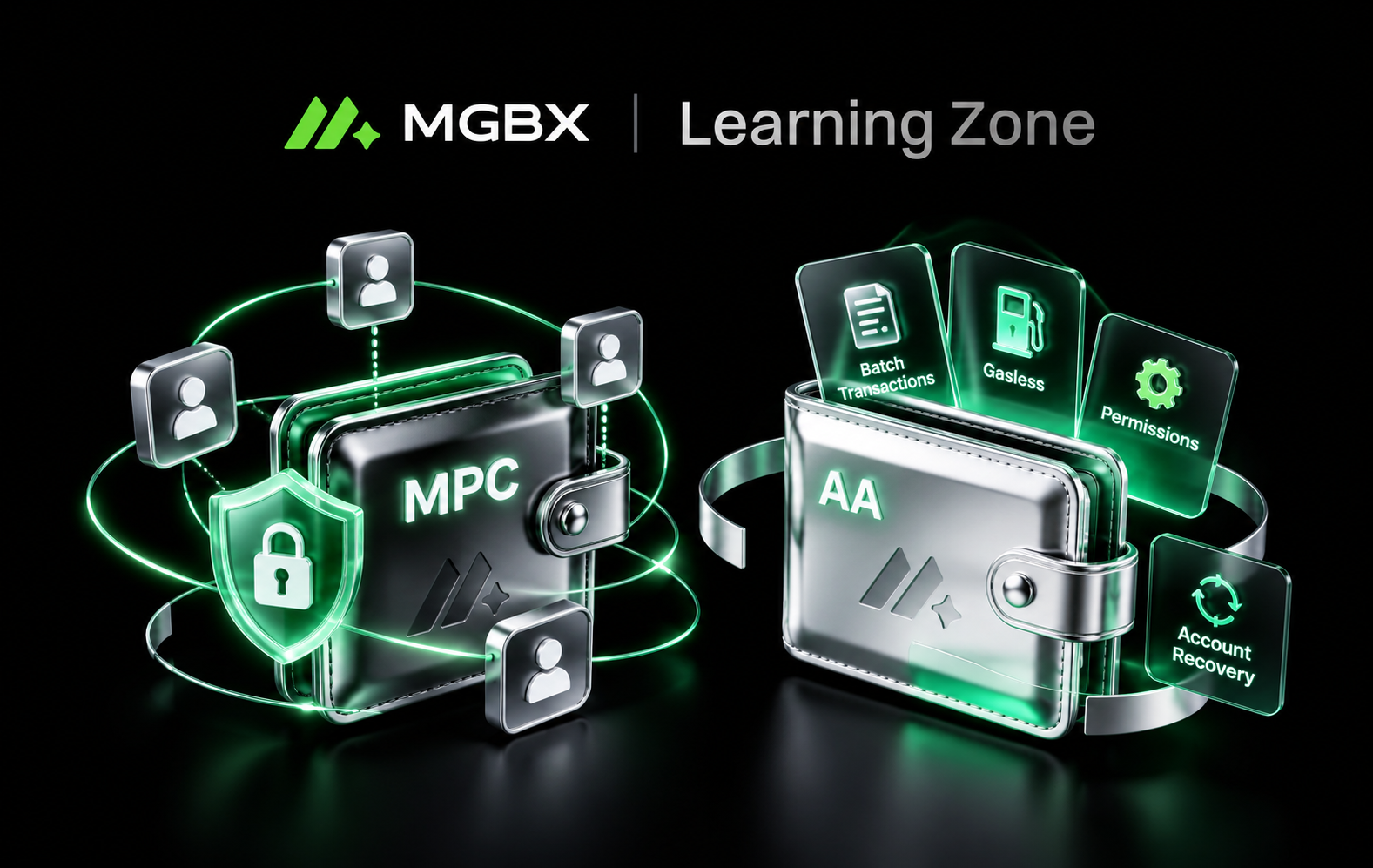
Traditional wallets often rely on a single private key or seed phrase, creating risks if credentials are lost or exposed. MPC wallets use Multi-Party Computation and distributed key shares to reduce single points of failure, while Account Abstraction wallets use programmable smart accounts to support batch transactions, sponsored fees, permission management, and account recovery. MPC and AA solve different problems and can also be used together. A more user-friendly wallet experience does not eliminate risk, so users still need to understand service dependencies and smart contract permissions.
What Are the Main Pain Points of Traditional Web3 Wallets?
Traditional Web3 wallets are commonly based on Externally Owned Accounts, or EOAs. Users control the account through a private key or seed phrase and use the private key to sign each transaction.
This design is relatively simple, but it creates a clear single point of failure. If a seed phrase is exposed, an attacker may gain control of the account. If it is permanently lost, the user may also lose access to the wallet.
Traditional wallets also require users to understand blockchain networks, Gas fees, token approvals, and transaction signatures. For beginners, one incorrect approval can put assets at risk, while complex workflows can make Web3 applications harder to use.
As a result, next-generation smart wallets are developing in two main directions. One changes how keys are stored and used for signing, with MPC wallets as a representative approach. The other changes how accounts verify and execute transactions, with Account Abstraction wallets as a leading model.
How Do MPC Wallets Reduce Single-Point Risk?
MPC stands for Multi-Party Computation. MPC wallets commonly use threshold cryptography to distribute signing authority across multiple participants or devices.
Different MPC wallet designs work in different ways. Some use distributed key generation so that a complete private key never exists on a single device from the beginning, while others split key-related information into multiple shares.
When a transaction is signed, a required threshold of participants jointly computes the signature without reconstructing and exposing the full private key. NIST’s description of threshold cryptography also emphasizes that cryptographic operations can be carried out jointly while keeping secret shares distributed during the process.
MPC wallets can support device replacement, team approvals, and recovery mechanisms, but they do not eliminate risk completely. Users should still understand who stores the key shares, how recovery works, whether assets can be migrated if the provider stops operating, and whether the implementation has undergone security review.
What Are Account Abstraction and ERC-4337?
Account Abstraction, commonly shortened to AA, aims to make blockchain accounts programmable in how they verify and execute transactions.
AA smart contract wallets can support features such as batch transactions, daily limits, multi-device verification, social recovery, session keys, and sponsored transaction fees. Users are no longer limited to a single fixed private-key verification model.
ERC-4337 is one of the key approaches to implementing Account Abstraction on Ethereum. It introduces components such as UserOperation, Bundler, EntryPoint, and Paymaster, allowing users to submit actions through smart accounts.
A Bundler can package multiple UserOperations into an on-chain transaction; the EntryPoint handles validation and execution; and a Paymaster can cover Gas fees under specific conditions.
However, a “gasless transaction” does not mean that network fees disappear. The cost may instead be paid by the project, a service provider, or through another asset. Account Abstraction is also broader than ERC-4337 itself, which is one important implementation path within a wider account design concept.
How Should You Choose Between an MPC Wallet and an AA Smart Wallet?
MPC wallets mainly address key control and distributed signing, while AA smart contract wallets mainly address account verification and transaction logic.
The two approaches are not mutually exclusive. A smart contract wallet can use MPC for signing and may also combine passkeys, hardware devices, or social recovery mechanisms.
Individual users should consider whether the wallet supports independent account recovery, export or migration, clear transaction authorization, and transparent provider permissions. Enterprise users may also need to evaluate approval thresholds, employee access controls, audit logs, emergency pause functions, and key rotation mechanisms.
AA wallets may involve smart contract vulnerabilities, upgrade permissions, and additional Gas costs. MPC wallets may involve participant availability, key-share storage, and dependency on service providers. More advanced technology does not automatically mean that a specific wallet is safer.
The broader direction of Web3 wallet development is to turn complex security mechanisms into an experience that feels closer to Web2, while preserving verifiable and portable account capabilities.
Mastering the basics is the first step. Follow MGBX Academy to access more cryptocurrency educational resources and market opportunities.
The process for trading on MGBX:
Register a trading account and complete the necessary identity verification;
Deposit funds and select a trade type;
On the cryptocurrency trading page, enter the amount or quantity of the cryptocurrency you wish to purchase;
Confirm the order to complete the trade, and check that your assets have increased accordingly.
Further Readings:
What Is Web3: A Complete Guide to the Next Generation of the Internet
The Web3 Technology Stack: Explained in 5 Minutes
What Is Web3 Identity (DID): The Vision of Self-Sovereign Identity